 Promethean
The Brief
The CEOs of ten major U.S. airlines and cargo carriers — including American, Delta, United, Southwest, JetBlue, and Alaska — published a joint open letter demanding Congress restore Department of Homeland Security funding and pay TSA workers, now 29 days into a partial government shutdown. The letter coincides with the start of the busiest spring break travel week, jet fuel prices that have nearly doubled since the Iran war began, and over 300 TSA officers quitting since the shutdown started on February 14.
The Report
Ten airline and cargo executives published an open letter in The Washington Post on Sunday calling on Congress to pass three bipartisan bills — the Aviation Funding Solvency Act, the Aviation Funding Stability Act, and the Keep America Flying Act — that would guarantee pay for air traffic controllers and TSA officers regardless of government funding status. The signatories include CEOs from American Airlines, Delta, United, Southwest, JetBlue, Alaska Air Group, UPS, FedEx, and Atlas Air, along with the president of Airlines for America.
“TSA officers just received $0 paychecks,” the letter stated. “That is simply unacceptable. It’s difficult, if not impossible, to put food on the table, put gas in the car and pay rent when you are not getting paid.”
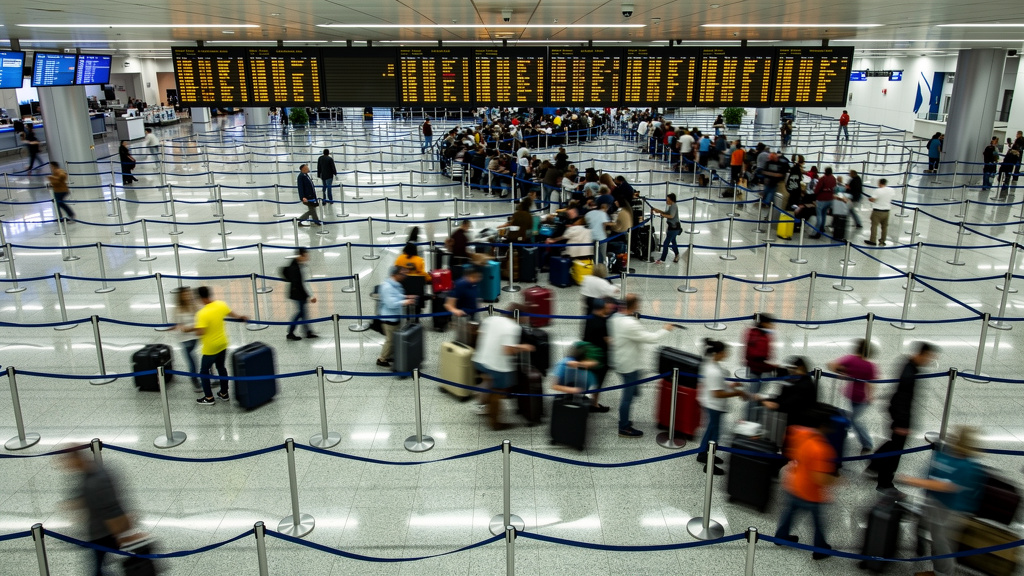
The DHS partial shutdown, which began February 14 over a dispute between Democrats seeking immigration enforcement reforms and Republicans resisting those changes, has left more than 100,000 federal workers without pay. Over 300 TSA officers have quit since the shutdown started, following the departure of more than 1,000 security officers during a previous shutdown in the autumn of 2025. Unscheduled absences have more than doubled at several major airports, producing security lines of two to four hours at hubs including Houston, Atlanta, New Orleans, Orlando, and Austin.
The staffing crisis arrives as the industry faces a simultaneous fuel shock. Jet fuel spot prices hit $3.99 per gallon on Friday — up from $2.50 the day before the Iran war started on February 28 and roughly double the price from a year ago. Iran’s declaration of the Strait of Hormuz as “closed” following U.S. and Israeli airstrikes has disrupted approximately 20 percent of the world’s oil supply. The International Energy Agency estimates the conflict is cutting global oil supply by roughly eight million barrels per day in March.
Airlines are responding. Cathay Pacific doubled its fuel surcharges. Air France-KLM announced increases of approximately 50 euros per long-haul roundtrip. United Airlines CEO Scott Kirby warned fare increases would “probably start quick.” Spirit Airlines advanced ticket prices spiked 124 percent for the week of March 27. UBS cut its American Airlines 2026 earnings estimate from $2.21 to $0.43 per share and reduced Delta’s forecast from $7.17 to $5.85, citing fuel exposure.
Democrats have attempted six times to pass standalone bills funding TSA, FEMA, and the Coast Guard while negotiations over ICE and Border Patrol continue. Senate Republicans blocked five of those bills in a single 24-hour period last week. The White House has blamed Democrats for the shutdown, while Senate Majority Leader John Thune offered a more measured assessment: “This is kind of a new low, really.”
Airlines for America projects 171 million passengers will fly during the eight-week spring travel window. TSA expects to screen 2.8 million passengers daily through March and April — an all-time record. The busiest week of spring break kicked off Sunday.
The Angle
What is striking about the airline CEOs’ letter is not its content — the ask is modest and the tone is measured — but the fact that it needed to be written at all. This is the third shutdown in less than a year to leave TSA workers unpaid. The industry response has escalated from quiet lobbying to public letters in national newspapers, which is itself a data point about how seriously the people who run air travel infrastructure assess the dysfunction.
The convergence is the story. Either crisis alone would strain the system. A fuel shock rewrites the economics of every route. A staffing crisis degrades the physical capacity to move people through airports. Arriving simultaneously, at the start of peak demand, they expose something the system was not built to handle: two unrelated external shocks compounding through the same bottleneck at the same time.
The fuel crisis has a cause that will resolve on a timeline set by geopolitics. The staffing crisis has a cause that could be resolved in an afternoon — Congress has the bills, drafted and bipartisan, sitting on the table. The airline executives framed this as an appeal. It is more precisely a description: Congress has the tools to fix one of these two problems immediately and is choosing not to use them, while the one it cannot fix accelerates underneath.
Passengers are still paying the $5.60 security fee on every flight segment. The revenue continues to accrue. The officers it was designed to fund continue to work without receiving it. That specific detail — money collected, services demanded, payment withheld — is the kind of structural fact that tends to outlast the political arguments surrounding it.