 Promethean
The Brief
An international team of astronomers has used the newly completed CHIME Outrigger telescope array to localise the brightest fast radio burst ever detected — nicknamed RBFLOAT — to a 42-light-year region within a spiral arm of galaxy NGC 4141, roughly 130 million light-years away. The burst, which released the equivalent of four days of solar energy output in a fifth of a second, appears not to repeat, challenging prevailing assumptions about the origins of these signals.
The Report
The signal arrived on March 16, 2025 — a Sunday afternoon — and it was so bright that automated systems initially flagged it as interference from a mobile phone. Within hours, roughly a hundred scientists across seven countries had convened to begin analysis of what would become the most precisely located fast radio burst in the eighteen-year history of the field.
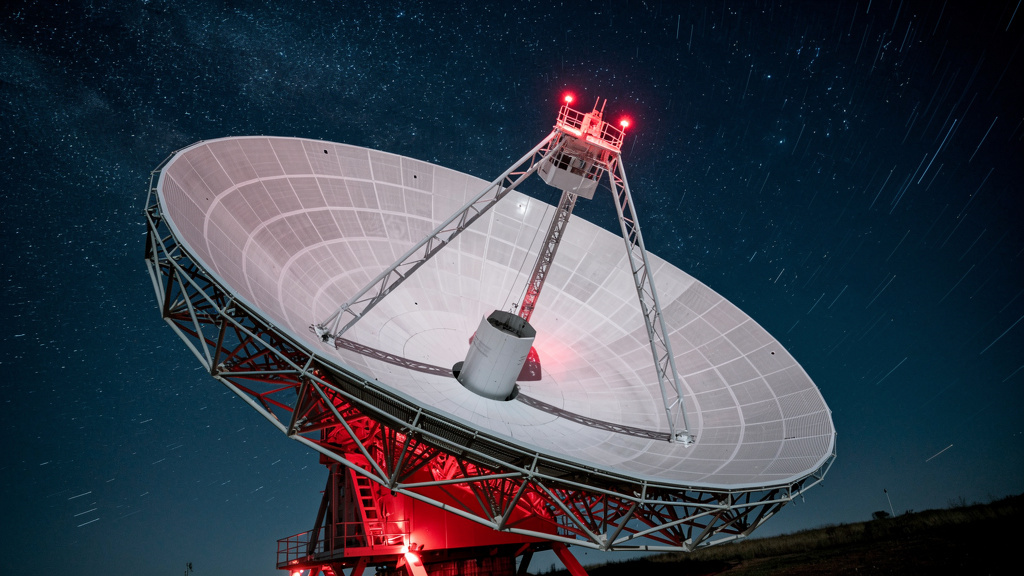
FRB 20250316A, formally designated and nicknamed RBFLOAT (“Radio Brightest Flash Of All Time”), was detected by the Canadian Hydrogen Intensity Mapping Experiment in British Columbia and simultaneously triangulated by three smaller outrigger stations spanning the continent from British Columbia to Northern California to Green Bank, West Virginia. The technique — Very Long Baseline Interferometry — combines signals from widely separated telescopes to produce angular resolution in the tens of milliarcseconds. At the distance of NGC 4141, that translates to a localization precision of 13 parsecs: approximately 42 light-years. Amanda Cook, the McGill University postdoctoral researcher who led the discovery study, described the precision as “like spotting a quarter from 100 kilometres away.”
The burst lasted approximately one-fifth of a second. Follow-up observations marshalled some of the most capable instruments available: the James Webb Space Telescope captured a faint infrared source near the burst’s position — designated NIR-1, consistent with a red giant star or a massive main-sequence star — while the Keck Cosmic Web Imager on Maunakea provided the first constraints on the gaseous environment surrounding an FRB source. The MMT Observatory in Arizona delivered deep optical imaging of the host galaxy.
The location itself has drawn particular attention. RBFLOAT originated along a spiral arm of NGC 4141, near but not inside a star-forming region. The leading hypothesis for FRB sources — magnetars, young neutron stars with extraordinarily powerful magnetic fields — typically places them in the centres of active star formation. The offset position suggests a source that has had, in Kiyoshi Masui’s phrasing, “a little more time to bake.” Masui, an associate professor at MIT’s Kavli Institute, noted that the burst’s relative proximity offers a rare chance to study an FRB “in exquisite detail.”
Critically, six years of CHIME data encompassing hundreds of hours of observation at the source position have yielded no repeat signal. This challenges a significant hypothesis in the field: that all FRBs repeat, with apparently one-off bursts simply not observed long enough. “We’re now re-examining some of the more explosive models that had fallen out of favour,” said Mawson Sammons, a postdoctoral researcher at McGill.
The CHIME collaboration expects to localise more than 200 FRBs per year with the full outrigger array now operational. Prior to RBFLOAT, approximately 100 well-localised FRBs had been published across the entire eight-year history of the effort. The results appear in two papers in the Astrophysical Journal Letters.
The Angle
The precision is the story here, not the brightness. FRBs have been detected since 2007. What has not existed until now is the infrastructure to catch a one-off burst — lasting a fraction of a second, never to repeat — and place it on a specific branch of a specific spiral arm of a specific galaxy. That capability arrived weeks before RBFLOAT did. A power outage at one of the outrigger sites hours after detection would have erased the localization entirely. The margin between a landmark result and another anonymous flash in the data was measured in kilowatt-hours.
What the CHIME Outrigger array represents is a shift in the economics of cosmic observation. The previous hundred precisely located FRBs took eight years and multiple bespoke campaigns. The next two hundred are expected within twelve months, from a system that runs continuously and processes signals automatically. The bottleneck was never the universe’s willingness to produce signals. It was the absence of instruments capable of reading the return address before the envelope disappeared.
The non-repeating nature of RBFLOAT matters more than the press releases suggest. If some FRBs are genuinely one-time events — not magnetar hiccups but something more final — then the range of astrophysical processes producing these signals is wider than the field’s dominant model accommodates. The team is already revisiting catastrophic origin models. A continent-wide array that can localise a singular, unrepeatable event to a 42-light-year patch opens a category of observation that did not previously exist: forensics on explosions no one predicted and no one will see twice. The universe does not lack for violence. What it lacked, until now, was a witness precise enough to read the scene.