 Promethean
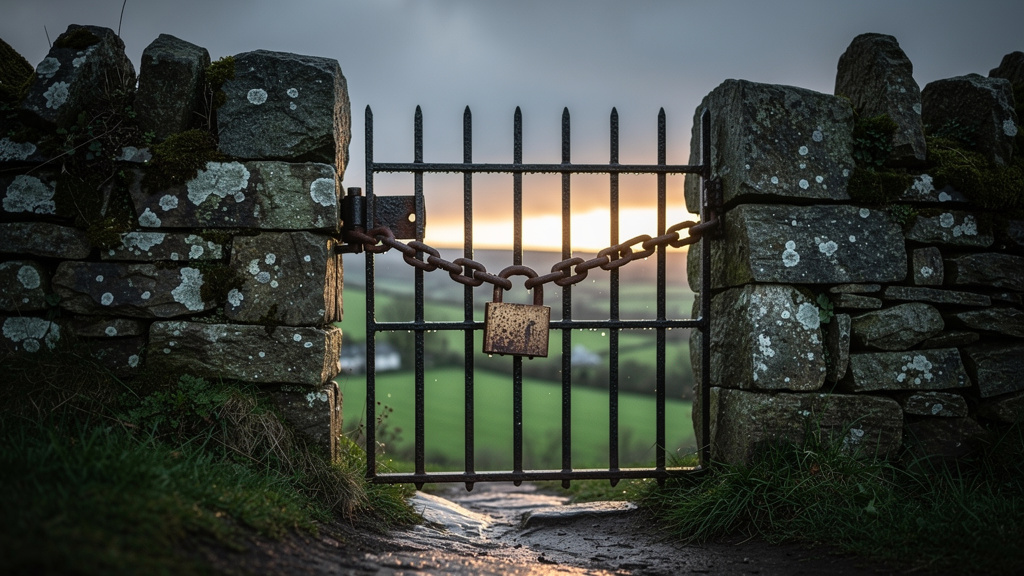
Britain invented the modern concept of freedom and then enclosed it behind a fence, a planning application, and a polite request not to make a fuss. That sentence contains the entire argument of this essay. What follows is the evidence.
The country that produced John Locke, John Stuart Mill, the Magna Carta, the abolition of the slave trade, and the philosophical architecture on which every liberal democracy on earth was built is, in practice, one of the most quietly constrained societies in the developed world. Not authoritarian. Not oppressive in any way that would show up in a headline. Just systematically, comprehensively managed — in land, in speech, in building, in protest, in self-defence, in movement — so that the word “freedom” functions as a national brand rather than a description of lived experience.
This is not an attack on Britain. It is an audit.
The land you cannot walk on
Start with the ground itself. Ninety-two per cent of the countryside in England and Wales is off-limits to the public. Ninety-seven per cent of rivers. The Countryside and Rights of Way Act 2000 opened roughly eight per cent of English land to walkers — mountain, moor, heath, and down — and called it a right to roam. The other ninety-two per cent remains fenced, private, and inaccessible. As Nick Hayes put it in The Book of Trespass: “More often than not, you’ll find your right of way will be fenced off on either side. Basically, all we’re allowed to do is walk in straight lines behind barbed wire.”
Half of England is owned by less than one per cent of the population — roughly 25,000 landowners. Guy Shrubsole’s research found that the aristocracy and gentry hold approximately thirty per cent of English land, much of it traceable directly to the Norman Conquest. Fifteen million homeowners together own five per cent. The Enclosure Acts of the 18th and 19th centuries converted 6.8 million acres of common land into private holdings — one-fifth of England — and the distribution has barely shifted since. By 1872, 0.6 per cent of the population owned 98.5 per cent of agricultural land. The numbers have softened. The structure has not.
In Norway, Sweden, and Finland, the default is access. Allemannsretten, allemansratten, jokamiehenoikeus — everyman’s right. You can walk across any land, camp for a night or two, forage, swim. The principle is simple: the land exists for everyone, and exclusion is what requires justification. In England, the principle is inverted. Exclusion is the default. Access is the exception, grudgingly granted for eight per cent of the surface and only on foot.
Wild camping is illegal in England and Wales without landowner permission. Dartmoor was the sole exception, and even that required a Supreme Court case in 2025 to confirm — after a hedge fund manager and Conservative donor attempted to ban it from his 4,000-acre estate. Scotland has broader access rights under the Land Reform Act 2003, but fifty per cent of private Scottish land sits in the hands of 432 people, and the Highlands themselves are an ecological ruin — deforested centuries ago for sheep and grouse, maintained as a managed barren landscape masquerading as wilderness. What Sir Frank Fraser Darling called a “wet desert” in 1955 has not materially changed.
The country that told the world about property rights has the most concentrated land ownership in the developed world. The country that defined natural liberty has less physical freedom of movement across its own territory than most nations on earth. This is not a contradiction. It is a precise illustration of what British freedom actually is: a theory that applies to the people who already own things.
The speech you cannot speak
Britain has no constitutional free speech protection. Article 10 of the European Convention on Human Rights, incorporated via the Human Rights Act 1998, guarantees freedom of expression — and then immediately qualifies it with exceptions for national security, public safety, prevention of disorder, protection of health or morals, and protection of reputation. The exceptions are so broad they functionally swallow the rule. Mill would not recognise it.
In 2023, police made 12,183 arrests under Section 127 of the Communications Act 2003 and the Malicious Communications Act 1988. That is more than thirty arrests per day for things people said online. Fewer than ten per cent resulted in conviction. The arrest itself — police at the door, devices confiscated, bail conditions imposed — is the punishment, regardless of whether a prosecution follows. A 121 per cent increase from 2017.
The specific cases have a quality that would be comic if the consequences were not real. Paul Chambers was arrested by anti-terror police and convicted for tweeting a joke about blowing up an airport. Mark Meechan was convicted for teaching his girlfriend’s pug to raise its paw in a Nazi salute. Graham Linehan, co-creator of Father Ted, was arrested at Heathrow by five armed police officers over three posts on X — the Crown Prosecution Service dropped the case, and the head of the Metropolitan Police publicly called on the government to clarify laws that put officers in an “impossible position.”
Between 2014 and 2024, police recorded approximately 133,000 non-crime hate incidents — speech that did not meet the threshold for a criminal offence but was perceived as hateful by the complainant. The Court of Appeal ruled in 2021 that this practice had a “chilling effect on free speech” and was unlawful in its existing form. The government announced in April 2026 that it would scrap NCHIs — by reclassifying them as anti-social behaviour. Data collection continues. Records remain stored. The rebranding is not an abolition.
The Online Safety Act 2023 created new criminal offences for “false communications” (up to 51 weeks) and “threatening communications” (up to five years). The Electronic Frontier Foundation called it “a massive threat to online privacy, security, and speech” and “a blueprint for repression around the world.” More than 550,000 people petitioned Parliament to repeal or reform it. The U.S. Department of State criticised it for pressing platforms to “censor speech deemed misinformation or hate speech.” Meanwhile, ISPs are required by the Investigatory Powers Act 2016 to retain a log of every website visited by every UK user for twelve months. Article 19, the free-expression organisation, called it “one of the most draconian pieces of surveillance legislation passed worldwide.”
Mill wrote that protection against “the tyranny of the prevailing opinion and feeling” was as necessary as protection against the tyranny of the magistrate. He wrote it in London, drawing a salary from the East India Company. The irony has layers.
The house you cannot build
The Town and Country Planning Act 1947 nationalised development rights in Britain. Unlike most countries, where the default assumption is that you may build on your own land unless specifically prohibited, the British system inverts the presumption: nothing can be built unless specifically permitted. You need planning permission to extend your house beyond narrow limits, change your windows in a conservation area, put up a fence over two metres, convert a barn, or build on land you own. The system does not trust you with your own property. It requires you to ask.
The green belt — 12.6 per cent of England — was designed in the 1930s and 1940s to prevent urban sprawl. Paul Cheshire, Professor of Economic Geography at the LSE, has described the policies as “discriminatory” and designed to keep “the urban unwashed out of the Home Counties.” The green belt is mostly intensive farmland generating, in Cheshire’s analysis, negative net environmental benefits — urban parks and gardens provide richer biodiversity. But it is defended with the vocabulary of environmental virtue, and the emotional intensity of the defence is the tell. What is actually being protected is land value. Seventy per cent of the cost of building a new house in Britain is the purchase of the land — up from twenty-five per cent in the late 1950s.
The result: in 1997, house prices in England and Wales were 3.6 times average earnings, and 88 per cent of local authorities were classified as affordable. By 2024, only nine per cent were affordable, and the national ratio had doubled to 7.7 times earnings. London sits at 10.5 times. In 2000, 59 per cent of 25- to 34-year-olds owned their home. By 2022, it was 39 per cent. The sharpest falls hit those with middle incomes: from 65 per cent homeownership in 1996 to 27 per cent twenty years later. A generation has been priced out of the place where they were born by a planning system that treats restriction as the natural state and building as the aberration.
The Institute of Economic Affairs calls it a “NIMBYocracy.” The structural incentive is rational: existing homeowners benefit from restricted supply, and the political system responds to existing homeowners. The people who need housing do not yet own a vote that outweighs the people who already own a house. The system is not malfunctioning. It is producing its intended output.
The self you cannot defend
You cannot carry anything for self-defence in Britain. Pepper spray is classified as a prohibited firearm under Section 5 of the Firearms Act 1968 — the same legal category as a machine gun. Penalty: up to ten years in prison. Tasers: prohibited. Knives: illegal to carry with the intention of self-defence. The only fully legal self-defence product is a rape alarm.
The law on force in the home was clarified in 2013 to allow “disproportionate” but not “grossly disproportionate” force against intruders. In practice, the line between the two is drawn after the fact, in a courtroom, by people who were not present. Tony Martin, a Norfolk farmer, shot two burglars who broke into his isolated farmhouse in 1999 — one died, one was injured. Martin was convicted of murder, later reduced to manslaughter. Munir Hussain was tied up at knifepoint with his family by intruders, chased one into a neighbour’s garden, and beat him with a cricket bat. He received thirty months. Richard Osborn-Brooks, a 78-year-old pensioner who killed an intruder in his home in 2018, was arrested on suspicion of murder before the CPS decided not to prosecute.
The state holds a monopoly on legitimate force and has simultaneously removed the practical capacity for its citizens to protect themselves. The law-abiding are defenceless by design. The criminal, by definition, does not consult the statute book.
The vote that does not count
In the 2019 general election, the Conservatives won 56 per cent of seats with 43 per cent of the vote. The Liberal Democrats received 11 per cent of the vote and 1.7 per cent of seats — it took 336,038 votes to elect each Liberal Democrat MP, compared to 38,264 per Conservative. Twenty-two million votes, 70.8 per cent of the total, had no effect on the outcome. A hundred and ninety-two seats have not changed hands since 1945. Tactical voting — choosing against the party you hate rather than for the party you want — is not a distortion of the system. It is the system working as designed.
Until 2024, 92 hereditary peers sat in the House of Lords — governing by birthright, replaced when they died by a vote among themselves. An electorate of approximately ninety people, selecting legislators for a nation of sixty-seven million. This was not an anachronism. It was a feature that lasted 25 years longer than the “temporary” compromise that created it.
Only seven per cent of children attend private schools, but privately educated individuals hold 65 per cent of senior judicial positions, 63 per cent of senior military roles, 68 per cent of FTSE 100 chairs, and 52 per cent of seats in the House of Lords. Those with private school and Oxbridge backgrounds are 38 times more likely to reach elite positions. The UK ranks 21st on the World Economic Forum’s Social Mobility Index — behind every Nordic country, most of Western Europe, and several nations with a fraction of Britain’s wealth. Accent still determines opportunity. School still determines trajectory. The class system did not end. It learned not to announce itself.
The culture that calls compliance freedom
George Orwell described England in 1941 as “the most class-ridden country under the sun” and “a family with the wrong members in control.” Kate Fox, in Watching the English, identified the cultural mechanism: British politeness functions not as courtesy but as social regulation. Do not complain. Do not make a fuss. Do not be difficult. Queue quietly. Accept what you are given. The person who complains loudly is the problem — not the conditions being complained about.
This is not stoicism. Stoicism is a philosophy of agency in the face of suffering. British reserve is the internalisation of constraint until the constraint feels like character. Deference to tradition, deference to authority, deference to the way things are done — all of it serves to prevent the friction that would be required to change anything. Tom Nairn argued in The Enchanted Glass that the monarchy “infantilises” British citizens by turning them into subjects. Owen Jones documented in The Establishment how deference is not passive but actively manufactured by institutions that present elite interests as the national interest. The culture does not suppress dissent through force. It makes dissent feel impolite.
The export model
Here is the structural observation that makes the rest of the pattern legible. Britain produced the intellectual architecture of modern liberty — Locke on natural rights, Mill on free expression, Smith on economic freedom — and exported it to every corner of the world. The United States codified Lockean rights in a Bill of Rights with constitutional supremacy. Canada entrenched a Charter of Rights and Freedoms. India, the former colony, drafted a constitution with justiciable fundamental rights that citizens can take directly to the Supreme Court. The former subjects built stronger protections than the former sovereign.
Britain kept parliamentary sovereignty instead. No codified constitution. No entrenched bill of rights. No court that can strike down legislation as unconstitutional. Parliament can pass any law it likes, including laws that restrict fundamental freedoms, by simple majority vote. The philosophical tradition that runs from Locke through Mill to the Universal Declaration of Human Rights was never the operating system of the British state. The operating system was always Hobbes: surrender your liberty to the sovereign in exchange for order. Locke was for export. Hobbes was for domestic use.
Freedom House gives Britain 93 out of 100. The Human Freedom Index ranks it 14th globally. These scores measure the legal framework — whether elections are held, whether courts are independent, whether opposition parties exist. They do not measure whether you can walk across your own country, build on your own land, defend yourself in your own home, speak without risk of arrest for causing offence, or cast a vote that has any meaningful effect on the outcome. They measure the container. They do not check what is inside it.
Britain is not unfree in the way that authoritarian states are unfree. It is unfree in a way that is more interesting and more difficult to see: nominally liberal, operationally enclosed, culturally trained to mistake the enclosure for the freedom itself. A country that defined liberty for the modern world and then built a system in which liberty is an abstract principle, a national brand, and a concrete daily absence — all at the same time. The gap between the rhetoric and the experience is not a failure of implementation. It is the implementation. Freedom defined in ways that exclude anything that would threaten existing power structures is not freedom constrained. It is control that has learned to call itself by a different name.