 Promethean
The Brief
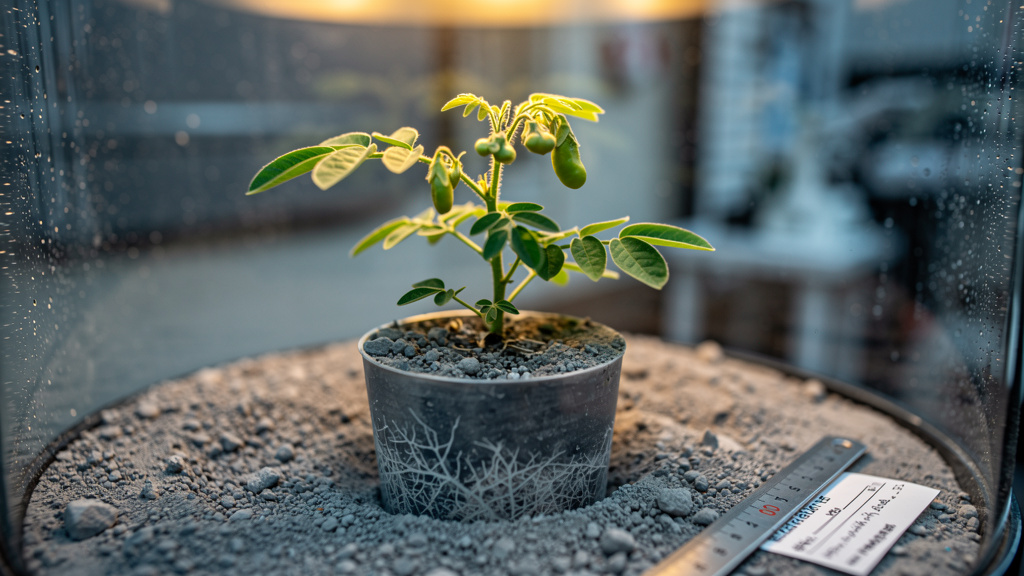
Researchers at the University of Texas at Austin have grown chickpeas to full harvest in mixtures containing up to 75 percent simulated lunar regolith — the first time a food crop has been cultivated to seed in moon-like soil. The team used arbuscular mycorrhizal fungi and worm compost to convert the sterile, metal-laden simulant into viable growing medium, with the fungi also limiting uptake of harmful metals by the plants.
The Report
A team led by Sara Oliveira Santos, a distinguished postdoctoral fellow at the University of Texas Institute for Geophysics, and Jessica Atkin, a doctoral candidate at Texas A&M University, has successfully grown the ‘Myles’ variety of chickpea to seed in soil mixtures dominated by simulated lunar regolith. The peer-reviewed results, published in Scientific Reports, represent the first time a food crop has completed its full growth cycle in a lunar soil analogue.
Lunar regolith — the fine, abrasive dust that covers the Moon’s surface — contains no organic matter and no microorganisms, the two prerequisites for arable soil. It also carries elevated concentrations of metals including aluminium and zinc, and its powder-like consistency resists water filtration. The simulant used in the study, produced by Exolith Labs in Florida, is 99 percent compositionally accurate to samples returned by Apollo astronauts.
To convert this hostile medium into something capable of supporting plant life, the researchers applied two biological amendments. Vermicompost — nutrient-rich material produced by red wiggler earthworms — supplied organic matter and a diverse microbial community. Arbuscular mycorrhizal fungi, coated onto the chickpea seeds before planting, formed a symbiotic relationship with the plants’ root systems. The fungi performed a dual function: enhancing absorption of essential nutrients while reducing uptake of toxic heavy metals. Critically, the fungi colonised and persisted in the simulant without needing reintroduction, suggesting a single inoculation could establish a lasting biological presence in actual lunar soil.
Chickpeas grew successfully and produced seeds in mixtures containing up to 75 percent regolith simulant. Plants grown at higher concentrations survived — those treated with fungi lasted approximately two weeks longer than untreated controls in pure simulant — but showed significant stress and reduced seed production. A cotton wick-based irrigation system delivered water directly to the root zone.
“We want to understand their feasibility as a food source,” Atkin said. “How healthy are they? Do they have the nutrients astronauts need? If they aren’t safe to eat, how many generations until they are?”
The chickpea variety was chosen for its compact growth, stress tolerance, and high protein content — qualities suited to the constraints of a lunar habitat. Unlike leafy greens and lettuce, which dominate most space agriculture research, chickpeas offer caloric density and actively recruit beneficial microorganisms through chemical signalling from their roots.
The research, initially self-funded by Santos and Atkin, now operates under a NASA FINESST grant. NASA separately runs a logistical reuse project in which earthworms process mission waste — coffee grounds, food scraps, cotton clothing — into the same type of vermicompost used in the study, providing a plausible pathway for generating soil amendments from materials already present on crewed missions.
The harvested chickpeas are currently undergoing testing for nutritional content, protein levels, and metal accumulation. The study builds on a 2022 University of Florida experiment that grew Arabidopsis thaliana in actual Apollo-era lunar soil — the first plant growth in real regolith — but those plants were harvested after 20 days, well before flowering, and showed considerable stress. NASA’s Artemis IV mission, targeting 2028, would be the first crewed lunar landing since Apollo 17 in December 1972.
The Angle
The distinction worth noting is between growing a plant and growing food. The 2022 Florida experiment proved that biology can take hold in lunar material. This study answers a different question — whether lunar material can be converted, using only biological tools a crew could carry, into something that produces a harvest. The gap between those two results is the gap between survival and settlement.
What makes the finding structurally interesting is the mechanism. The fungi are not a temporary fix. They colonise the regolith, persist without reintroduction, and improve conditions for the next planting cycle. Each generation of growth converts more dead mineral dust into something incrementally closer to living soil. The researchers are not describing a way to grow a single crop. They are describing the first stage of terraforming — performed not by industrial machinery but by organisms that have been doing exactly this work for four hundred million years on Earth.
The NASA waste-reuse detail is easy to pass over and worth pausing on. The vermicompost required for the process can be generated from mission waste that would otherwise be discarded. The fungi need only be introduced once. The irrigation system uses cotton wicks. Every component of the system is either self-sustaining or derived from materials already present on a crewed mission. This is not agriculture imported wholesale from Earth. It is agriculture bootstrapped from what is already there — which is the only kind that scales.
Atkin’s question — “how many generations until they are safe to eat?” — frames the remaining problem correctly. The answer is not a binary. It is iterative. Each planting cycle the fungi pull more metal from the regolith and the biological community deepens. The soil improves. The question is not whether lunar agriculture is possible. It is how many harvests it takes before the soil stops being a simulant and starts being a farm.
The last crewed landing on the Moon was fifty-three years ago. The tools to make the next one permanent just germinated in a university lab in Texas.
The first viable path to feeding a permanent human presence beyond Earth runs through a chickpea root and a four-hundred-million-year-old fungus.