 Promethean
The Brief
Anti-government protests in Cuba have spread to Santiago de Cuba, the island’s second-largest city, on their eighth consecutive night, with residents chanting “Down with the dictatorship” during prolonged blackouts that have left parts of the country without power for over twenty hours at a stretch. Security forces have sealed off neighbourhoods in Santiago, distributed long guns at police stations, and militarised Communist Party headquarters, following an attack on the party building in Morón where video captured what appears to be gunfire striking a young man — an account the state denies.
The Report
Residents of the Micro 9 neighbourhood in Santiago de Cuba’s José Martí district took to the streets in the early hours of Sunday, setting fire to rubbish containers and chanting demands for political freedom during an extended blackout. The demonstrations mark the furthest geographic spread of unrest that began on March 7 following the failure of the Antonio Guiteras thermoelectric plant — a breakdown that left 68 percent of the island without electricity simultaneously, the worst outage in Cuban history.
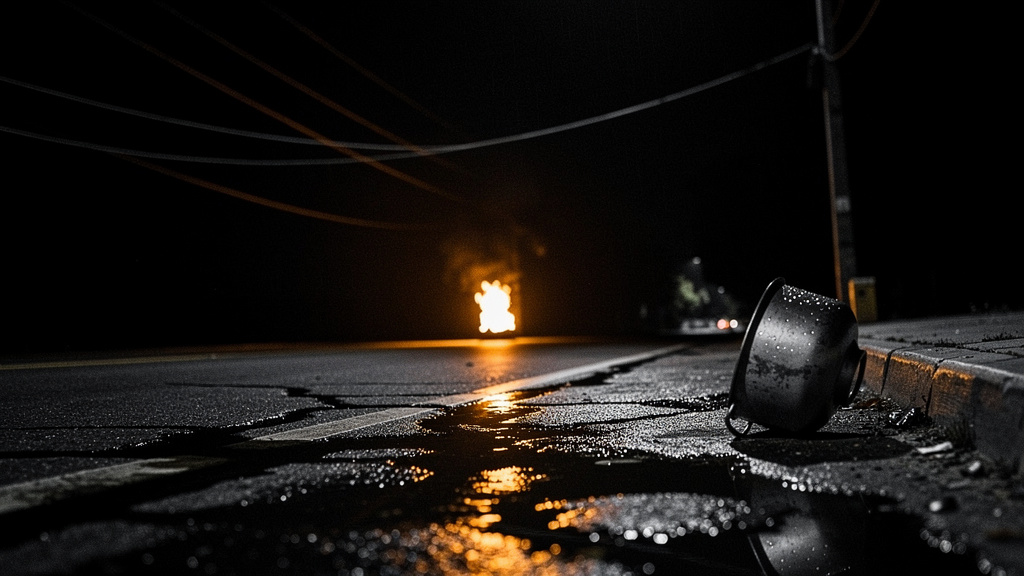
The protests have now been documented across at least six provinces: Havana, Matanzas, Ciego de Ávila, Holguín, Granma, and Santiago de Cuba. Nightly cacerolazos — the Latin American tradition of banging pots and pans — have become a fixture of the capital’s evenings, accompanied by graffiti reading “Se acabó” (“It’s over”) and the smell of burning rubbish from streets where vehicles no longer collect waste. University of Havana students staged a sit-in on March 9 over class disruptions. By March 13, the unrest escalated sharply when protesters in Morón, a town 250 miles east of Havana, stormed the local Communist Party headquarters, threw furniture into a street bonfire, and attempted to set the building ablaze. One protester wrapped himself in the Cuban flag and climbed a pole; when someone suggested burning it, another replied: “No, don’t burn it because that’s ours, that’s our freedom.”
Video obtained from the Morón incident captured what sounds distinctly like gunfire near the party building entrance, followed by a young man collapsing. Witnesses can be heard screaming, “They shot him! They said they wouldn’t shoot, but they shot him.” State outlet Vanguardia de Cuba denied anyone was struck, claiming the man fell while intoxicated. Human rights group Justicia 11J reported gunfire and a possible shooting. In Santiago, authorities responded to Sunday’s protests with patrol vehicles, prisoner transport vans, plainclothes State Security agents with dogs, and “black berets.” A minor was reportedly assaulted while defending his father during an arrest. A pregnant woman was beaten during a police intervention.
President Miguel Díaz-Canel acknowledged the frustration was “understandable” given the blackouts but warned there would be “no impunity for vandalism.” On March 13 he confirmed talks with the Trump administration — the first official acknowledgement of diplomatic contact — comparing them to Obama-era negotiations while noting Cuba remains “in the initial phases” and “still far from an agreement.” Cuba announced the release of 51 prisoners following Vatican-mediated negotiations, though at least 760 political prisoners remain in Cuban jails according to Justicia 11J.
The energy crisis stems from a near-total fuel blockade. No petroleum shipments have reached Cuba in three months. The fall of Venezuela’s Nicolás Maduro in January cut off two-thirds of Cuba’s energy imports, and Executive Order 14380 imposed tariffs on any country supplying oil to the island. Cuba has lost an estimated 90 percent of its fuel supply. Mexico has sent over 3,000 tons of humanitarian aid since February. The UN is reportedly in talks with Washington to ease the blockade for humanitarian fuel deliveries. On March 14, Raúl Castro’s 41-year-old grandson, Raúl Guillermo Rodríguez Castro — who had previously held secret talks with Secretary of State Marco Rubio’s team — appeared publicly alongside Díaz-Canel for the first time.
The Angle
The journalist Yosmany Mayeta Labrada, reporting from Santiago, noted something worth pausing on: the protesters were not asking for electricity. They had no electricity, no water, no food — and they were chanting “Down with the dictatorship.” The demand had decoupled from the grievance. That is a specific and historically recognisable phase shift. People who protest blackouts want the lights back on. People who protest during blackouts but demand political freedom have made a different calculation about what is actually broken.
Díaz-Canel’s response has been a study in managing two audiences with contradictory messages. To his population: complaints are legitimate, violence will not be tolerated, the blockade is to blame. To Washington: quiet confirmation of talks, a Vatican-brokered prisoner release calibrated to signal flexibility without conceding anything structural, and the sudden public surfacing of Raúl Castro’s grandson — a man with no official title but effective control of the military’s economic apparatus — as if to say: here is who you would actually be negotiating with. The prisoner release itself is instructive. Fifty-one inmates announced for “good behaviour,” without specifying how many are political. At least 760 political prisoners remain. The gesture is sized precisely to be describable as a concession without functioning as one.
What makes Cuba’s position structurally distinct from previous crises is the removal of the pressure valve. The island’s energy grid was already failing — five nationwide blackouts in eighteen months — before the blockade reduced fuel supply by 90 percent. The regime’s traditional survival mechanism has been to endure external pressure by distributing deprivation evenly enough that no single breaking point emerges. That mechanism requires a minimum energy floor to operate: enough electricity to pump water, enough fuel to move food, enough light to maintain the basic infrastructure of daily life. The floor is gone. Twenty-hour blackouts do not produce distributed frustration. They produce synchronised desperation across entire provinces, which is a different kind of problem for a security apparatus that depends on isolating dissent geographically.
The Castro grandson’s emergence is the detail that carries the most forward weight. A regime signalling through backchannels that the revolutionary generation’s chosen interlocutor is a 41-year-old with no ideological portfolio and effective control of the economy is not a regime preparing to defend its system. It is a regime preparing to negotiate the terms on which the system changes shape — while the streets outside are making their own calculations about whether those terms will arrive in time.
The eight nights of protests have not yet produced a July 11, 2021-scale rupture. What they have produced is something the regime has less practice managing: a population that has stopped requesting repairs to the existing arrangement and started questioning whether the arrangement is the thing that needs replacing.