 Promethean
The Brief
Bahrain, Saudi Arabia, and the UAE scrambled to intercept Iranian projectiles on Sunday after Tehran issued evacuation warnings for three major Emirati ports — Jebel Ali, Khalifa, and Fujairah — marking the first time Iran has directly threatened a neighboring country’s civilian infrastructure since the war began three weeks ago. Iran claims the U.S. launched strikes on Kharg Island from UAE territory, an allegation the Emirates categorically deny.
The Report
Gulf states reported fresh missile and drone attacks Sunday as the war between Iran, Israel, and the United States entered its third week with no diplomatic off-ramp in sight. Iranian armed forces had issued evacuation notices the previous day for three of the UAE’s most strategically significant ports, designating them “legitimate targets” due to what Tehran called the concealment of American military assets within civilian facilities.
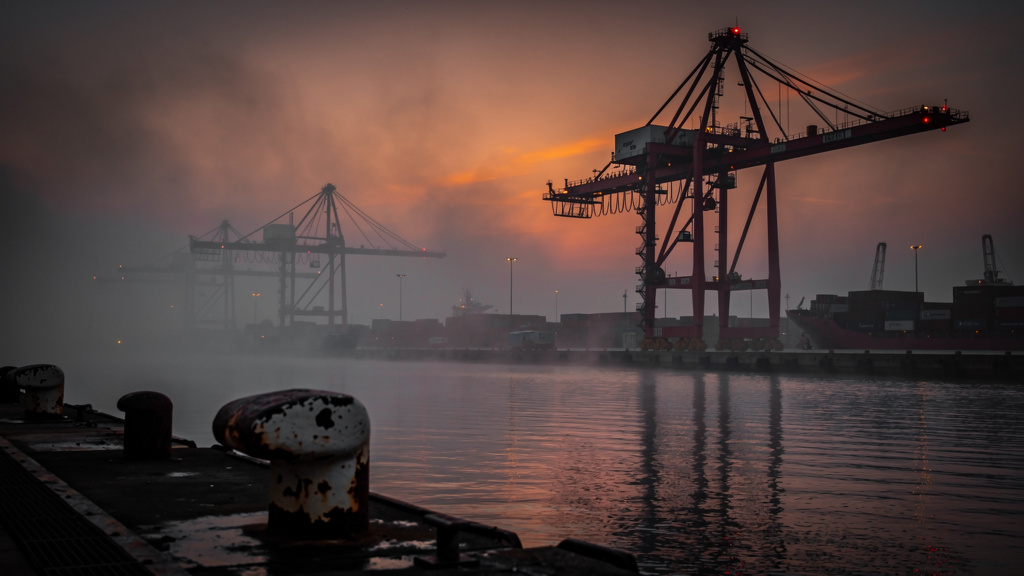
The three ports — Jebel Ali in Dubai, the Middle East’s busiest container hub handling over 19 million TEUs annually; Khalifa in Abu Dhabi; and Fujairah, a key oil export terminal situated outside the Strait of Hormuz — represent critical nodes in global maritime trade. A fire broke out at Fujairah on Saturday after debris from an intercepted drone struck an oil facility, temporarily suspending loading operations before they resumed Sunday.
Iran’s Foreign Minister Abbas Araghchi alleged that the U.S. had attacked Kharg and Abu Musa islands using artillery launched from “Ras Al-Khaimah and a place very close to Dubai.” He provided no evidence. U.S. Central Command declined to respond to the claim. In a separate appearance on CBS’s Face the Nation, Araghchi was unapologetic about strikes on Gulf neighbours. “Obviously these are the countries who have given their soil to American forces to attack us,” he said. “So what can we do?”
Anwar Gargash, senior diplomatic adviser to the UAE president, rejected Iran’s accusations as “part of a confused policy that has misdirected its aim, lost its compass, and forsaken wisdom.” He characterised Iran’s strategy of targeting Arab Gulf states as evidence of “military impotence, moral bankruptcy, and political isolation,” adding that the UAE retains the right to self-defence while continuing to prioritise restraint.
Since the war began on February 28, Gulf air defences have intercepted over 3,100 Iranian missiles and drones across six nations — the UAE alone accounting for hundreds of ballistic missiles and more than a thousand drones. At least two dozen civilians, most of them migrant workers, have been killed by Iranian strikes in Gulf states. In Iran, more than 1,300 people have died according to the International Committee of the Red Cross; Iran’s Health Ministry puts the figure higher at 1,444, with 223 women and 202 children among the dead.
The war has driven Brent crude above $103 per barrel — a 40 percent increase since the conflict began — with the Strait of Hormuz, through which roughly one-fifth of global oil transits daily, effectively impassable to commercial shipping. The IEA authorised the release of 400 million barrels from emergency reserves, the largest such action in history, though analysts note the stockpile would be absorbed within a month at current supply deficits. President Trump called on China, Japan, South Korea, the UK, France, and others to send warships to secure the strait. Araghchi described the appeal as “begging.”
Saudi Arabia intercepted and destroyed ten drones over Riyadh and its eastern region on Sunday. Bahrain reported cumulative interceptions of 125 missiles and 203 drones since the conflict began. Kuwait, Qatar, Jordan, and Oman have all sustained attacks. Formula One cancelled its April races in Bahrain and Saudi Arabia. The UN Security Council adopted Resolution 2817, backed by 135 co-sponsors, condemning Iran’s strikes on regional states — the largest co-sponsorship of a Security Council resolution in history.
Araghchi told Al-Araby al-Jadeed that Iran would consider any proposal involving “a complete end” to the war, though he gave no indication of progress. On Face the Nation, he was blunter: “We never asked for a ceasefire, and we have never asked even for negotiation.”
The Angle
The port threat is the pivot point of this week, and it is worth being precise about why. For three weeks, Iran has framed every strike on its neighbours as retaliation against American assets — a distinction that allowed Gulf states to absorb the damage without being forced into a direct military response. The evacuation warnings for Jebel Ali, Khalifa, and Fujairah discard that framework entirely. These are not American installations. They are the commercial arteries of the Gulf economy and, by extension, of a global supply chain that runs through them on its way between Asia, Europe, and Africa. Naming them as targets is not an escalation in degree. It is an escalation in kind.
The logic of Iran’s position reveals its own contradiction. Araghchi insists Iran targets only American military assets. The armed forces simultaneously designate the Middle East’s busiest civilian port a legitimate target on the basis that American forces might be concealed within it — a claim unsupported by evidence and denied by every party except Tehran. What is actually happening is more straightforward than the diplomatic language allows: Iran cannot reach the adversaries who struck it, so it is reaching for the neighbours who happen to be nearby. Gargash’s description — military impotence dressed as strategic escalation — is unusually accurate for a diplomatic statement.
The Gulf states now occupy a position their security architecture was specifically designed to avoid. For decades, the GCC model was to host American military infrastructure while maintaining just enough diplomatic distance from Washington’s conflicts to preserve relationships with Tehran. That distance has been closed — not by the Gulf states’ own actions, but by Iran’s decision to treat proximity to the U.S. as complicity with it. The 3,100 intercepted projectiles are a technical achievement. The question they leave unanswered is whether interception remains a sufficient response once the targets shift from military bases to the ports that underwrite a quarter-trillion dollars of annual trade. Defence analysts are already predicting that the UAE and Saudi Arabia will seek to restore deterrence through means beyond air defence. The infrastructure of Gulf neutrality — always more diplomatic fiction than strategic reality — is being dismantled by the one country it was designed to manage.