 Promethean
The Brief
Iran’s Revolutionary Guards struck at least three commercial vessels attempting to transit the Strait of Hormuz on Wednesday, hitting the Thai-flagged bulk carrier Mayuree Naree and the Liberian-flagged Express Rome with projectiles that sparked fires and left three crew members missing. The attacks — the most direct escalation against civilian shipping in the 12-day US-Iran war — came as tanker traffic through the strait collapsed to less than 2% of normal volume, prompting the International Energy Agency to announce a record 400-million-barrel release from emergency oil reserves.
The Report
Iran’s Islamic Revolutionary Guard Corps fired on multiple commercial vessels in and near the Strait of Hormuz on Wednesday, marking the war’s sharpest escalation against civilian shipping and the clearest signal yet that Tehran intends to enforce its declared closure of the waterway.
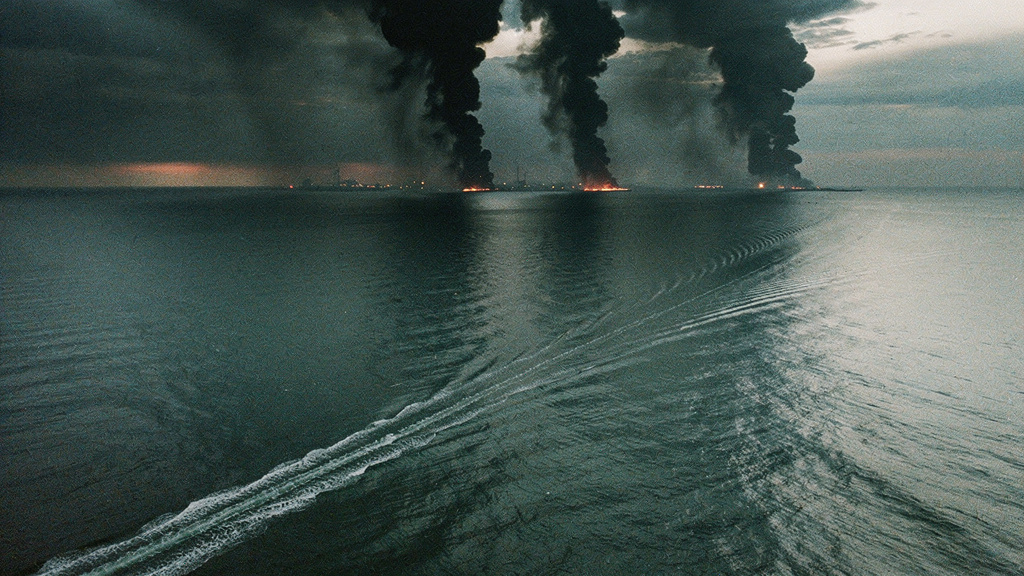
The Thai-flagged bulk carrier Mayuree Naree, a 30,000-deadweight-ton vessel operated by Bangkok-listed Precious Shipping, took two projectiles above the waterline approximately 11 nautical miles north of Oman. The strikes detonated in the engine room, triggering fires that sent thick black smoke across the upper deck. Of 23 Thai crew members, 20 were extracted by Omani naval forces and brought ashore at Khasab. Three remain missing, believed trapped in the engine room where they were on duty at the time of the explosions. The ship had been sailing in ballast from Khalifa Port in the UAE to Gujarat, India.
The IRGC claimed responsibility for the Mayuree Naree attack and a strike on the Liberian-flagged container ship Express Rome, stating both vessels were hit after “disregarding warnings and insistently attempting to illegally pass through the Strait of Hormuz.” Iran described the Express Rome as Israeli-owned — a claim not independently confirmed. Two additional vessels sustained projectile damage on Wednesday: the Japanese-flagged ONE Majesty, anchored 52 nautical miles from the strait, and the Marshall Islands-flagged Star Gwyneth, struck 50 nautical miles northwest of Dubai. Neither attack was claimed by Iran.
IRGC Naval Commander Alireza Tangsiri declared that every vessel intending to pass must obtain Iran’s permission. Tehran’s Khatam al-Anbiya military command stated Iran “will never allow even a single liter of oil to pass through the Strait of Hormuz for the benefit of the United States, the Zionists, or their partners.” An IRGC spokesperson added: “Expect oil at $200 per barrel.” President Trump warned that any disruption to oil flows would be met with force “20 times harder.” Defense Secretary Pete Hegseth said the U.S. would not allow “terrorists to hold the Strait of Hormuz hostage.” India’s Ministry of External Affairs deplored the targeting of commercial shipping, noting that “precious lives, including of Indian citizens, have already been lost.”
UK Maritime Trade Operations has now logged 17 incidents since the conflict began on February 28, including 13 confirmed attacks. Seven seafarers have been killed, according to the UN International Maritime Organization. The Hormuz Strait Monitor recorded only two ships crossing in 24 hours on Wednesday — less than 2% of normal tonnage through a corridor that carries roughly 20 million barrels of petroleum daily, or one-fifth of global consumption. The IEA responded by unanimously approving a 400-million-barrel release from emergency reserves across 32 member nations, more than double the previous record set during the 2022 Ukraine crisis. Brent crude rose 4.76% to $91.98 per barrel. EU Commission President Ursula von der Leyen said the 10-day conflict had already cost European taxpayers approximately €3 billion in additional fossil fuel imports.
CENTCOM reports it has struck more than 5,500 targets inside Iran and destroyed over 60 ships, reducing Iran’s naval presence in the Gulf of Oman from 11 vessels to zero. The attacks on unarmed merchant ships continued regardless.
The Angle
The most revealing number from Wednesday is not three ships struck or three crew missing. It is two — the number of vessels that crossed the Strait of Hormuz in 24 hours, against a pre-war baseline of hundreds. CENTCOM has destroyed over 60 Iranian ships and reduced Iran’s Gulf of Oman fleet from 11 to zero. The strait closed anyway.
This is the structural fact the military tallies obscure. Naval superiority was built to guarantee freedom of navigation in open water. The Strait of Hormuz is not open water. It is a 21-mile corridor flanked by Iranian coastline, and a country with shore-based projectiles and a willingness to fire on unarmed bulk carriers does not need a navy to make it impassable. The U.S. has won the naval war comprehensively. Iran has made that victory irrelevant to the question that actually matters — whether oil moves.
The IEA’s response puts a number on the gap between the problem and the available tools. Four hundred million barrels — the largest emergency release in its history — sounds significant until you note it covers roughly four days of global production, or sixteen days of Gulf transit volume. The world’s strategic buffer against the closure of its most critical energy corridor is measured in weeks. Gary Ross of Black Gold Investors called the disruption “double that of the Russian outage in 2022.” That comparison understates the difference. The Russian outage redirected supply chains. This one has severed one. The infrastructure of industrial civilisation still runs, as it has for half a century, through a chokepoint narrower than most cities — and the contingency for its closure is to spend down a reserve that took decades to accumulate, at a rate that buys time but not a solution.