 Promethean
The Brief
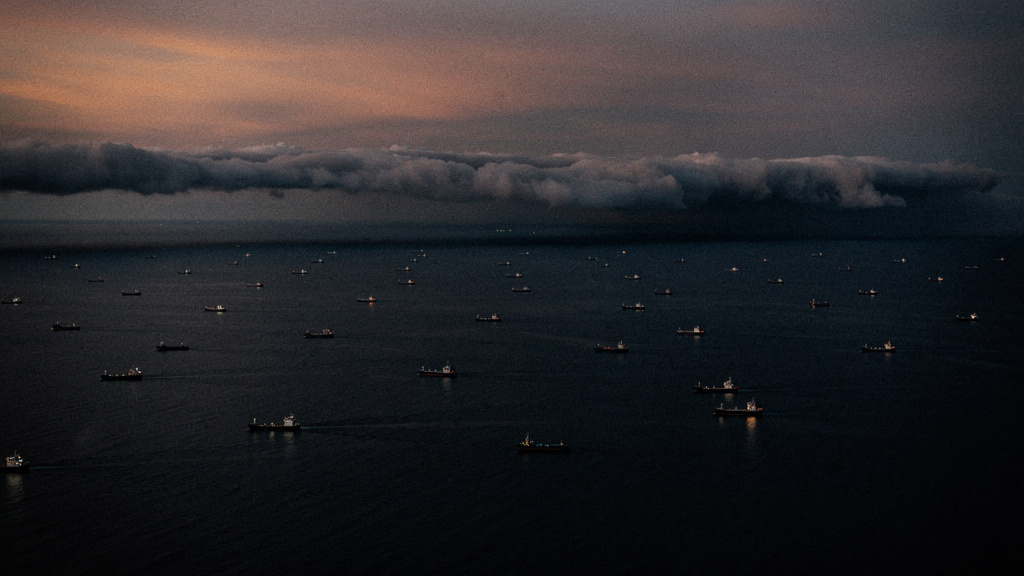
Iran’s Foreign Minister Abbas Araghchi declared the Strait of Hormuz “open, but closed to our enemies” on day seventeen of the US-Israeli war against Iran, as roughly 1,000 vessels — including over 500 oil tankers carrying an estimated 314 million barrels — sit stranded across the Persian Gulf and Arabian Sea. Traffic through the 21-mile waterway, which normally carries one-fifth of the world’s seaborne oil, has collapsed by approximately 90%, and the International Energy Agency has called the disruption the largest in the history of the global oil market.
The Report
Iran’s foreign minister drew a formal distinction on Sunday between nations Tehran considers hostile and those it does not, telling interviewers that the Strait of Hormuz remains navigable for “countries who want to talk to us about safe passage” while staying closed to the United States, Israel, and their allies. The practical effect of the distinction has been minimal. Brent crude opened the day at $102.14 per barrel — up more than 50% from the $68 it traded at before the war began on February 28 — and the strait that once handled 130 commercial transits daily now sees one or two.
The blockade’s mechanics extend beyond military threat. Insurance premiums for vessels transiting the strait have spiked to 3% of hull value, up from 0.25% — an increase of roughly 1,000% — making transit financially unviable for most commercial operators even where it is physically possible. At least sixteen ships have been struck by projectiles or explosive-laden boats since hostilities began. Eight crew members have been killed. More than 1,650 vessels have experienced GPS disruption, with 231 showing positional anomalies consistent with systematic spoofing. Day rates for willing operators have surged past $700,000.
The IEA responded by coordinating the largest strategic reserve release in its history — 400 million barrels across 32 member nations, including 172 million from the US Strategic Petroleum Reserve. The volume represents approximately four days of global consumption. Energy strategist Naif Aldandeni described it as “a small bandage on a large wound.” US gasoline prices have climbed to $3.63 per gallon nationally, up from $2.94 a month ago, with California already at $5.37.
President Trump demanded that China, France, Japan, South Korea, and Britain send warships to secure the strait, warning that “the U.S. will remember” non-cooperation. The response was cautious to the point of refusal. Germany’s foreign minister stated plainly: “Will we soon be an active part of this conflict? No.” France indicated willingness to discuss an escort mission only “when circumstances permit.” China called on “all parties” to ensure stable energy supply without committing to action. Only India secured actual passage — two LPG tankers crossed on March 14 after direct negotiations between Prime Minister Modi and Iran’s President Pezeshkian, providing limited relief to 333 million Indian households facing cooking gas shortages.
On the ground, the war’s toll continues to mount. Over 1,200 Iranian civilians have been killed and more than 3.2 million displaced, according to Iran’s health ministry. Thirteen US service members are dead. In Lebanon, where the conflict has reignited the Hezbollah-Israel front, the death toll has passed 850. A drone struck a fuel depot near Dubai International Airport, and Iran warned it would target US-linked energy infrastructure regionally if its own oil facilities face direct attack. The IRGC maintains that “not a litre of oil” will reach the US or its allies, and has promised oil at $200 per barrel.
Bob McNally, a former White House energy adviser, offered the assessment that has so far proven most durable: “There are no policy solutions to a prolonged closure.”
The Angle
Araghchi’s framing — open to neutrals, closed to enemies — is doing more diplomatic work than military work. The strait is not selectively blocked the way a border checkpoint filters traffic. It is functionally shut because the financial and operational architecture that moves oil through it has collapsed. Insurance markets do not distinguish between a waterway that is “closed” and one where a thousand-percent premium spike, GPS spoofing across 1,650 vessels, and projectile attacks on sixteen ships have made transit commercially impossible. The result is the same. The framing is for the negotiating table, not the shipping lane.
What the framing reveals is the position Iran is actually in — and it is not the one either side’s rhetoric suggests. Tehran cannot reopen the strait selectively in any operationally meaningful way, because the conditions preventing transit are not under its precise control. But it also cannot afford to say the strait is simply closed, because that would concede the act of war that invites the full naval response Trump is trying to assemble. So the language splits the difference: technically open, practically shut, diplomatically flexible. India got two tankers through. Turkey received clearance for one, with fourteen pending. These are not signs of a functioning waterway. They are individual diplomatic transactions conducted at head-of-state level — the opposite of open commerce.
The deeper structural fact is the one McNally identified: there is no policy instrument that fixes this. Strategic reserves buy days, not weeks. Escort missions require a coalition that does not exist and an appetite for escalation that no named country has displayed. Pipeline alternatives — Saudi Arabia’s East-West line, the UAE’s Habshan-Fujairah route — carry a fraction of what the strait handles. The industrial world built its energy infrastructure on the assumption that a 21-mile waterway between Iran and Oman would remain open indefinitely. That assumption held for decades. It is not holding now, and the machinery to replace it does not exist at the required scale. The infrastructure of the industrial world was built on geography it does not control. On day seventeen, that has stopped being theoretical.
The largest oil disruption in recorded history is not being resolved by policy, coalition, or diplomacy. It is being resolved by which heads of state can get Tehran on the phone — one tanker at a time.