 Promethean
The Brief
The US-Israel war on Iran has entered its tenth day with Israeli strikes hitting Iranian oil storage facilities for the first time, killing at least four workers and blanketing Tehran in toxic black smoke, while Iran’s retaliatory missile and drone attacks have now struck targets across nine countries from Lebanon to the UAE. At least 1,255 people have been killed in Iran, 394 in Lebanon, eight US service members across the region, and 14 in Gulf states, as Brent crude surged past $119 per barrel and shipping through the Strait of Hormuz has fallen by 90 percent.
The Report
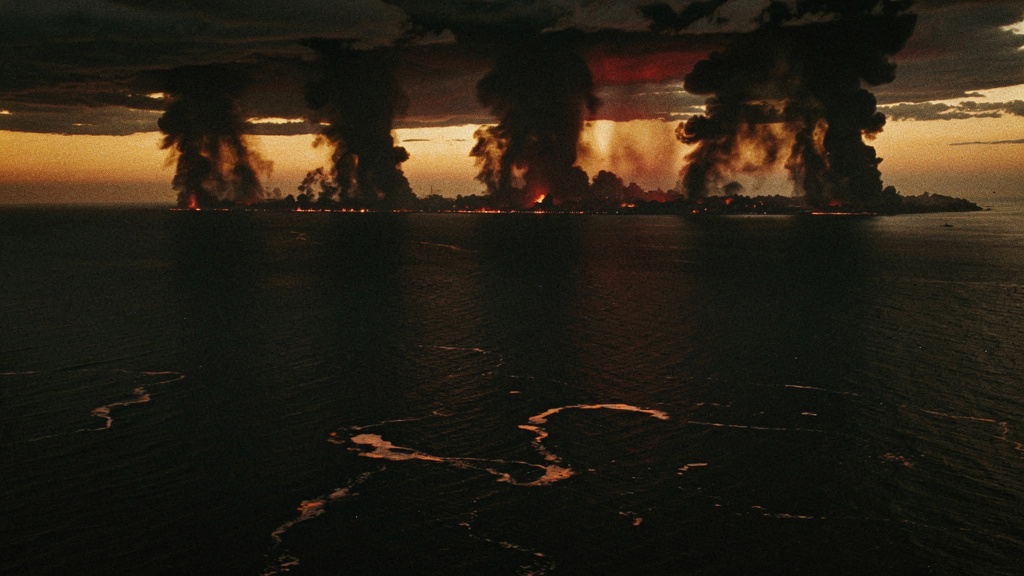
The US-Israeli campaign against Iran broadened significantly over the weekend as Israeli warplanes struck four oil storage facilities and one oil production transfer centre in and around Tehran — the first targeting of Iranian energy infrastructure since the war began on 28 February. The attacks on the Aghdasieh oil warehouse, the Tehran refinery, the Shahran oil depot and a facility in Karaj sparked large fires visible for miles, with oil from the Shahran depot leaking into surrounding streets. At least four tanker drivers were killed. Residents of Tehran reported black acidic rainfall on Sunday morning.
The oil strikes drew the first notable friction between Washington and Jerusalem. According to Axios, the scale of the Saturday attacks on some 30 fuel depots exceeded what the US had expected when Israel notified it in advance — marking the first significant disagreement between the allies since the campaign’s opening night.
Iran responded with continued missile and drone attacks across the region. Qatar’s Ministry of Defence reported intercepting 17 ballistic missiles and six drones launched from Iranian territory early Monday. Saudi air forces destroyed a drone heading toward the Shaybah oilfield. Bahrain’s state-run Bapco Energies declared force majeure after Iranian strikes hit energy installations and a desalination plant in Maameer. The UAE activated air defences against incoming threats. Kuwait International Airport fuel tanks were targeted. Two Bangladeshi nationals were killed in a strike on Kharj in Saudi Arabia, and Kuwait lost two border guards.
The conflict’s reach beyond Iran continued to deepen. In Lebanon, where at least 394 people have been killed and more than half a million displaced, Human Rights Watch documented Israeli use of white phosphorus munitions over the residential town of Yohmor on 3 March, calling it a violation of international humanitarian law. In Iraq, the Islamic Resistance claimed responsibility for over 23 drone strikes on US assets in Erbil. Six of the eight US service members killed in the war died in Iraqi operations.
Iran named Mojtaba Khamenei as supreme leader on 9 March, succeeding his father Ali Khamenei, who was assassinated in the opening strikes on 28 February. The Revolutionary Guard pledged allegiance to the younger Khamenei. He has made no public statements. President Trump called the appointment “unacceptable” and reiterated his demand for Iran’s “unconditional surrender.” Iran’s Foreign Minister Abbas Araghchi rejected calls for a ceasefire, stating Iran would “continue fighting for the sake of our people and our security.”
Brent crude surged to $119.50 per barrel on Monday before settling at $112.98 — a 27 percent weekly gain, the largest since the pandemic. Traffic through the Strait of Hormuz has dropped 90 percent since the IRGC declared it closed on 2 March. Seven seafarers have been killed in attacks on merchant vessels near the strait. The G7 has not yet agreed to release strategic oil reserves. Trump on Tuesday warned Iran would be hit “twenty times harder” if it maintained the blockade, briefly sending oil prices down 10 percent.
The Angle
The transition from military infrastructure to energy infrastructure is the story inside the story. For nine days, the campaign’s targeting list — air defences, missile launchers, IRGC headquarters, leadership compounds — followed a logic that was legible, if devastating: degrade Iran’s ability to fight back. Hitting oil depots follows a different logic. Oil storage facilities are not military targets in any operational sense. They are economic targets. Their destruction does not reduce Iran’s capacity to launch missiles. It reduces Iran’s capacity to function as a state.
That distinction matters because it redraws the line the campaign is operating on. A war aimed at military capability has a natural endpoint — when the capability is sufficiently degraded. A war aimed at economic infrastructure does not have that endpoint. It has a different one: compliance, or collapse. Trump’s demand for “unconditional surrender” is not diplomatic boilerplate from a president with a taste for blunt language. It is the stated objective that the targeting now matches. The oil strikes are the strategy catching up to the rhetoric.
The regional geometry is the second shift worth tracking. Iran’s retaliatory strikes on nine countries have done something no diplomatic process has managed in decades: they have placed the Gulf states inside the war rather than adjacent to it. Bahrain declaring force majeure on its state oil company is not a diplomatic incident. It is a country discovering that the conflict it was hosting bases for has arrived at its own infrastructure. The dead in Kuwait, Saudi Arabia, and the UAE are not combatants. They are the cost of proximity to a war whose boundaries were never agreed by the people living inside them.
The Strait of Hormuz — 90 percent reduction in traffic, seven seafarers dead — is where the economic and military tracks converge. A fifth of the world’s oil passes through a waterway now functionally closed by a country being bombed into accepting terms it has publicly refused. The G7’s inability to agree on releasing reserves is not indecision. It is the absence of a framework for what happens when the architecture of global energy supply is not disrupted by accident or market failure, but by deliberate military action undertaken by two of its guarantors. The institutions built to manage oil shocks were not designed for the scenario in which the shock is the policy.
Trump’s prediction that the war will end “very soon” and his threat to hit Iran “twenty times harder” moved oil prices 10 percent in a single session. The war’s economic instrument and its military instrument are now the same lever. The question no one in Washington or Jerusalem has publicly answered is what “unconditional surrender” looks like from a country that has just appointed a new supreme leader, whose foreign minister has rejected a ceasefire on the record, and whose remaining leverage — the Strait, the proxies, the regional missile network — is the kind that increases in danger precisely as the state that controls it loses the capacity to calibrate.
The first war fought simultaneously against a nation’s military, its economy, and the global energy system it sits on top of is now testing whether any of the institutions designed for only one of those problems at a time can hold.