 Promethean
The Brief
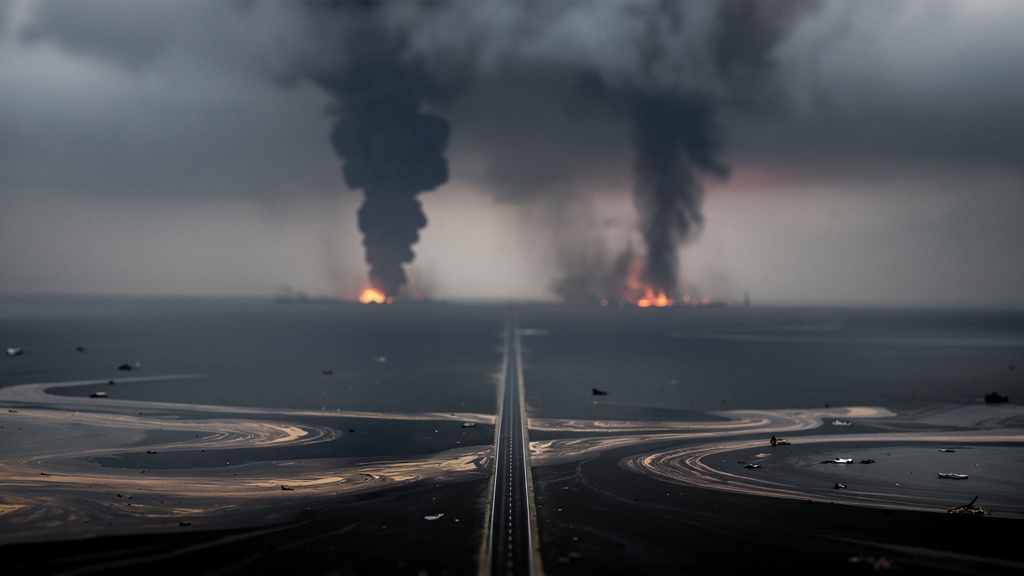
Iranian explosive-laden drone boats struck two oil tankers — the Marshall Islands-flagged Safesea Vishnu and the Malta-flagged Zefyros — in Iraqi territorial waters near Basra late Wednesday, killing one Indian crew member and setting both vessels ablaze. Iraq immediately suspended all oil terminal operations while commercial ports remain open. The attacks are the latest in a wave of at least six vessel strikes across the Persian Gulf in 24 hours, as the wider US-Iran conflict enters its thirteenth day.
The Report
Two foreign oil tankers were attacked by unmanned explosive-laden speedboats in Iraqi territorial waters near Basra late on the night of March 11, killing one Indian seafarer and prompting Iraq to shut down all oil terminal operations.
The Safesea Vishnu, a US-owned crude tanker flagged in the Marshall Islands and carrying approximately 48,000 metric tonnes of naphtha, was struck on the starboard side by what India’s Directorate General of Shipping described as “a white-coloured unmanned speedboat carrying explosives.” The impact triggered a major fire and forced the immediate evacuation of all 28 crew — 16 Indian nationals and 12 Filipino nationals. One Indian seafarer was confirmed dead. The Zefyros, a Greek-owned, Malta-flagged tanker carrying condensate from Iraq’s Basra Gas Company, was hit in the same area. Fire was still burning on both vessels at the time of reporting. A total of 38 crew members were rescued by Iraqi coast guard vessels and transported to Basra.
Farhan Al-Fartousi, Director General of the state-run General Company for Ports of Iraq, confirmed that “oil terminal operations have been fully suspended, though commercial port activities continue.” The tankers were struck in the ship-to-ship transfer area approximately 30 miles offshore, within Iraqi territorial waters. Specialised firefighting tugs were deployed from Basra Oil Port.
Lt. Gen. Saad Maan of Iraq’s Security Media Cell called the attacks “a cowardly act of sabotage” that “infringes on Iraqi sovereignty,” adding that Iraq “reserves the right to pursue the necessary legal measures.” Iraqi Prime Minister Mohammed Shia al-Sudani stressed that “Iraqi airspace, territory and waters are not used for military operations intended to target neighbouring countries.”
The strikes were part of a broader wave: six vessels were attacked across the Persian Gulf in 24 hours, including a Thai-flagged bulk carrier where three crew remain missing and a Japanese container ship struck near the UAE. Iran’s Islamic Revolutionary Guard Corps warned that any ship transiting the Strait of Hormuz would be targeted. The IRGC claimed direct responsibility for firing on at least one of the other vessels.
The operational shutdown compounds an already severe crisis for Iraq’s oil sector. Southern export volumes have collapsed from over 3.3 million barrels per day in February to roughly 800,000 bpd, a 70% decline that oil ministry officials have called “the most serious operational challenge facing the country’s oil sector in more than 20 years.” Iraq possesses only three days of crude storage capacity and depends on oil revenue for more than 90% of its national income. Oil Minister Hayan Abdul Ghani said Baghdad is pursuing alternative export routes, including restarting the Kirkuk-Ceyhan pipeline to Turkey’s Mediterranean coast, which could carry approximately 200,000 bpd.
Brent crude surged 9% to trade above $100 per barrel. The International Energy Agency announced a coordinated release of 400 million barrels from strategic reserves over four months, with the US contributing 172 million barrels. An IRGC representative warned the world should “prepare for oil prices to reach $200 per barrel.” Over 150 ships are now anchored outside the Strait of Hormuz, roughly 20,000 seafarers remain stranded in the Gulf, and the US Navy has declined repeated industry requests for military escorts through the strait, citing excessive risk.
The Angle
What happened in Iraqi waters on Wednesday night was not an attack on Iraq. Iraq understands this. The explicit statements from Baghdad — the sovereignty language, the insistence that Iraq is not a party to the conflict — are the vocabulary of a country watching its economic infrastructure become someone else’s battlefield and having no mechanism to prevent it.
The more consequential fact is the one buried in the production numbers. Iraq has lost 70% of its southern oil output in under two weeks. It has three days of storage. It funds more than 90% of its national budget from crude sales. There is no country on Earth more exposed to exactly this disruption, and the disruption is not a hypothetical stress test — it is happening, on day thirteen of a conflict whose endpoint no party has defined.
The IEA’s 400-million-barrel reserve release is calibrated to signal control. At current global consumption rates it represents roughly four days of supply spread across four months. It is a cushion, not a floor. The market’s 9% Brent surge on the same day the release was announced suggests traders reached the same conclusion. Strategic reserves address the symptom. The symptom is that a fifth of the world’s oil transits a corridor that one motivated actor can functionally close with drone boats and sea mines — and that no realistic military response changes the underlying geometry of the strait.
Iraq’s pivot to the Kirkuk-Ceyhan pipeline is the tell. At 200,000 barrels per day it replaces roughly 6% of what the southern terminals were moving. It is not a solution. It is the beginning of a conversation that should have happened decades ago: how an economy — and by extension, a global energy system — became structurally dependent on a chokepoint whose vulnerability was never theoretical, only untested. The test is now running. The infrastructure of the industrial world was built on geography it does not control.
The first country to lose most of its national income to a war it is not fighting will not be the last, so long as the global economy runs through corridors it cannot defend.