 Promethean
The Brief
Analysis of ancient sand dunes in Mars’s Gale Crater has revealed that groundwater seeped through fractures and deposited gypsum and other minerals billions of years ago, well after the planet’s lakes and rivers had vanished. The findings, published in the Journal of Geophysical Research: Planets by researchers at New York University Abu Dhabi, extend the known window of potentially habitable conditions on Mars into a period previously considered dry and lifeless.
The Report
A study of lithified sand dunes explored by NASA’s Curiosity rover has found mineral evidence that underground water persisted in Mars’s Gale Crater long after surface water disappeared, according to research led by Dimitra Atri at the NYUAD Space Exploration Laboratory.
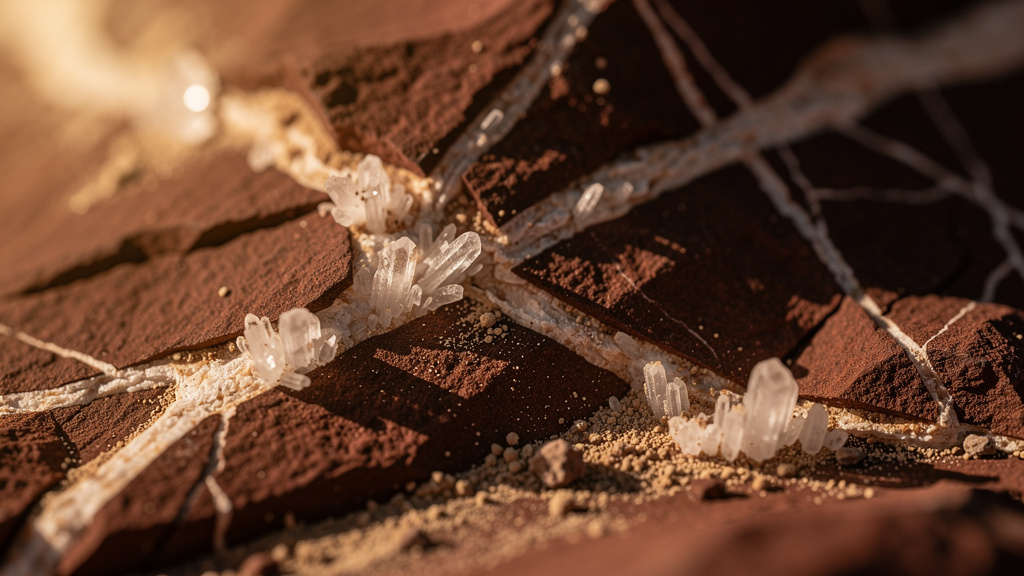
The team examined the Stimson Formation — a layer of ancient desert sandstone in the 154-kilometre-wide crater — and found that groundwater originating from nearby highlands had migrated upward through tiny fractures in the dunes, filling pore spaces and depositing calcium sulfate minerals including gypsum. The gypsum, which constitutes 20–24 percent of the crystalline fraction of certain Stimson samples, represents the first in-situ detection of that mineral on Mars. Critically, gypsum crystals are known to trap and shield organic molecules from Martian surface radiation, making these deposits potential preservation sites for biosignatures.
The research team compared Curiosity’s observations with naturally cemented dune formations at field sites in the United Arab Emirates — Liwa, Al Wathba, and Hatta — where similar lithification processes occur under comparable arid conditions. The terrestrial analogs allowed the researchers to reconstruct how loose Martian sand was transformed into solid rock through groundwater interaction, a process that implies sustained subsurface moisture well into the late Hesperian period, between 3.7 and 3.0 billion years ago. The previous consensus held that most of Mars’s water had been lost by the middle of that epoch.
“Our findings show that Mars didn’t simply go from wet to dry,” Atri said. “Even after its lakes and rivers disappeared, small amounts of water continued to move underground, creating protected environments that could have supported microscopic life.”
The results converge with independent findings. A 2024 study by Imperial College London’s Steven Banham, published in Geology, found deformed sandstone layers in the same Stimson Formation — contorted structures that indicate water was present as pressurised liquid, ice, or brine during what was thought to be a dry period. In February 2026, NASA announced the discovery of boxwork formations on Mount Sharp — grid-like ridges up to two metres tall, formed when groundwater deposited minerals along bedrock fractures. Tina Seeger, a mission scientist at Rice University, noted that boxwork at that elevation “suggests the groundwater table had to be pretty high.”
No evidence of actual life has been found. The significance lies in the extended timeline: subsurface environments shielded from radiation and temperature extremes remained wet — and therefore potentially habitable — for hundreds of millions of years longer than previously modelled. The European ExoMars rover and China’s Tianwen-3 mission, both targeting 2028 launches, will carry drills capable of reaching two metres below the Martian surface. Both missions now have a clearer target: the fracture networks and dune cements where water left its last traces.
The Angle
The standard narrative of Mars has always been a story of loss — a planet that had water, then didn’t. What the accumulating evidence from Gale Crater is quietly revising is not just the timeline but the category. Mars did not simply dry out. It retreated underground. Water moved from surfaces where we could see it into fractures and pore spaces where we couldn’t, and it stayed there long enough to deposit minerals that are, on Earth, reliable vaults for organic chemistry.
Three independent lines of evidence — mineral cementation, sediment deformation, and now the boxwork ridges high on Mount Sharp — point in the same direction without relying on each other. That convergence matters more than any single finding. One anomaly is an anomaly. Three separate research groups, using different methods, extending the same timeline in the same direction is a pattern resolving into a map.
The practical consequence is specific. Two missions launching in 2028 will carry drills built to reach two metres into Martian rock. The question those drills were designed to answer — whether Mars preserved any record of biology — now has a more precise address. Not the surface, which has been sterilised by radiation for billions of years. Not the deep subsurface, which remains unreachable. The fracture networks and gypsum-cemented sandstone where water was the last thing to leave, and where whatever it carried may still be legible.
What the Gale Crater data is assembling, piece by piece, is not proof of life. It is something that precedes proof: a map of where to look that is becoming difficult to ignore. The drills arrive in the early 2030s. The rock has been waiting for three billion years. The interval between those two facts is now measurable in years, and closing.
The first serious test of whether Earth is the only place biology happened is no longer a generation away. It is on a launch manifest.