 Promethean
The Brief
NASA convened the Flight Readiness Review for Artemis II at Kennedy Space Center on March 12, following weeks of repairs to a helium pressurisation fault in the SLS rocket’s upper stage that forced the vehicle back to the Vehicle Assembly Building. A second rollout to Launch Complex 39B is planned later this month, with two-hour launch windows available on the evenings of April 1, 3, 4, 5, and 6.
The Report
NASA completed the Artemis II Flight Readiness Review at Kennedy Space Center on Thursday, the final formal assessment of systems, personnel, and procedures before the agency commits to rolling its 32-storey Space Launch System rocket back to the launch pad for a second time.
The review follows a turbulent two months of technical setbacks. A wet dress rehearsal on February 3 was halted at T-minus five minutes and 15 seconds after automated systems detected a hydrogen leak at an umbilical plate on the first stage, eliminating the February launch window. A successful second rehearsal on February 19 appeared to clear the path for a March attempt — until engineers discovered overnight on February 21 that helium flow to the interim cryogenic propulsion stage had been interrupted. The upper stage relies on helium to maintain engine conditions and pressurise its liquid hydrogen and oxygen tanks.
NASA identified the cause on March 3: a seal in the quick-disconnect fitting connecting ground helium supply lines to the rocket had become dislodged, blocking flow. Technicians removed the fitting, repositioned the seal, and reinstalled it. Tests confirmed helium was flowing normally. Engineers are still investigating why the seal shifted in the first place.
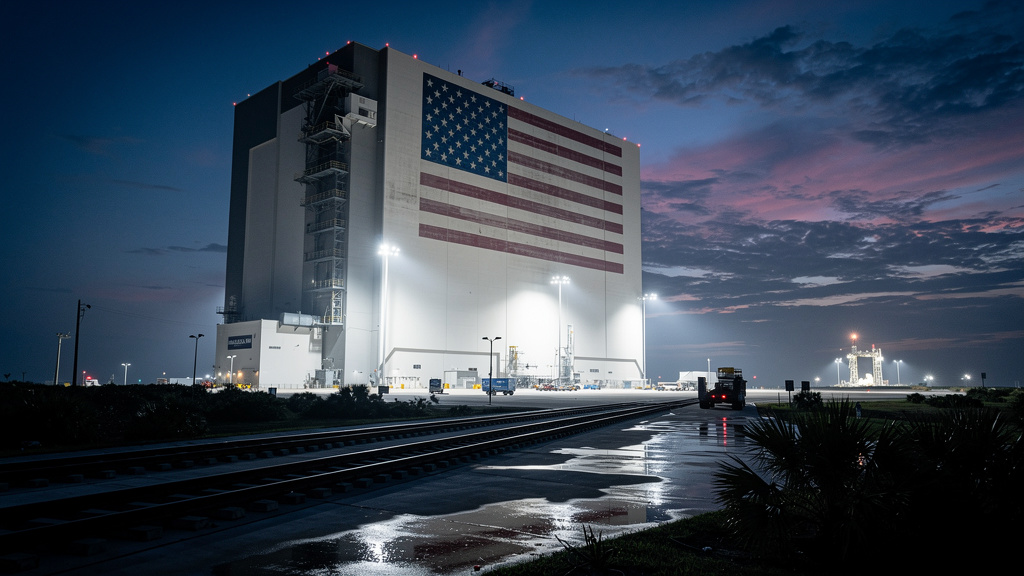
The 23.6-million-pound stack — rocket, Orion spacecraft, and mobile launcher — was hauled four miles back to the Vehicle Assembly Building on February 25 aboard the Apollo-era crawler-transporter, a journey that took roughly 12 hours. While there, teams replaced batteries across the core stage, upper stage, solid rocket boosters, and flight termination system, and swapped a seal on the core stage liquid oxygen feed line.
Administrator Jared Isaacman, who in late February announced a broader restructuring of the Artemis programme — adding missions, accelerating the landing timeline, and standardising vehicle configuration — is expected to confirm the mission’s readiness status. Once back at the pad, teams will need approximately ten days before any launch attempt.
Artemis II will send four astronauts — commander Reid Wiseman, pilot Victor Glover, and mission specialists Christina Koch and Canadian Space Agency astronaut Jeremy Hansen — on an approximately ten-day lunar flyby, tracing a figure-eight trajectory that carries them 40,000 miles around the far side of the Moon. It will be the first crewed voyage beyond low Earth orbit in more than half a century. Koch will become the first woman and Glover the first Black astronaut to travel to the Moon. A backup launch opportunity exists on April 30.
The Angle
What is worth noticing about Artemis II is not the delays — complex rockets have always found novel ways to not launch on schedule — but what the delays reveal about the distance between where NASA is and where it says it is going. Isaacman’s February restructuring committed the agency to annual lunar landings starting in 2028, an Artemis III shakedown flight in 2027, and a cadence that echoes the compressed Apollo timeline he explicitly invoked. The vehicle currently sitting in the VAB was rolled back because a seal shifted in a helium fitting. The gap between the stated ambition and the engineering reality is not a contradiction. It is the actual measurement of the problem.
The programme’s costs tell the same story from a different angle. At roughly four billion dollars per SLS launch and a total projected programme cost north of ninety billion, Artemis is not being evaluated against what it delivers. It is being evaluated against what it represents — the only operational architecture for putting humans beyond low Earth orbit. That distinction has insulated it from the kind of scrutiny that would retire any other system with a 140 percent budget overrun and a flight rate measured in years between missions. The question Isaacman’s restructuring implicitly answers is whether that insulation can hold long enough for the cadence to become real.
Fifty-three years between crewed lunar flights is not a gap. It is an aberration — a species that reached escape velocity and then chose, for two generations, not to use it. Artemis II does not close that gap. It tests whether the machinery for closing it still works. The answer, after a dislodged seal and two rollbacks and four months of delays, is: barely, expensively, and not yet at the pace the stated timeline requires.
The first humans to leave low Earth orbit in half a century will do so aboard a rocket that was delayed by a misaligned gasket. The distance between that fact and the programme’s stated destination is the only number that matters.