 Promethean
The Brief
Nscale, the UK-based AI infrastructure startup, has raised $2 billion in a Series C round led by Aker ASA and 8090 Industries — the largest such round in European history. The deal values the company at $14.6 billion, more than double its September 2025 valuation, and adds former Meta COO Sheryl Sandberg, former UK Deputy Prime Minister Nick Clegg, and former Yahoo President Susan Decker to its board. Nvidia, Dell, Lenovo, Nokia, Citadel, Jane Street, and Point72 participated alongside the lead investors.
The Report
Nscale has closed a $2 billion Series C funding round, setting a new record for European startup financing and pushing its valuation to $14.6 billion. Norwegian industrial conglomerate Aker ASA and investment firm 8090 Industries led the round, with participation from Nvidia, Dell Technologies, Lenovo, Nokia, Citadel, Jane Street, Point72, Astra Capital Management, and Linden Advisors. Goldman Sachs and JPMorgan acted as placement agents.
The company, founded in 2024 by CEO Josh Payne, builds and operates data centres optimised for AI workloads — offering GPU compute, networking, orchestration software, and managed Kubernetes services to enterprise customers running training, fine-tuning, and inference at scale. It operates facilities in Portugal, where it uses seawater cooling, and Texas, which runs closed-loop liquid cooling, with additional sites in the UK, Norway, and Iceland.
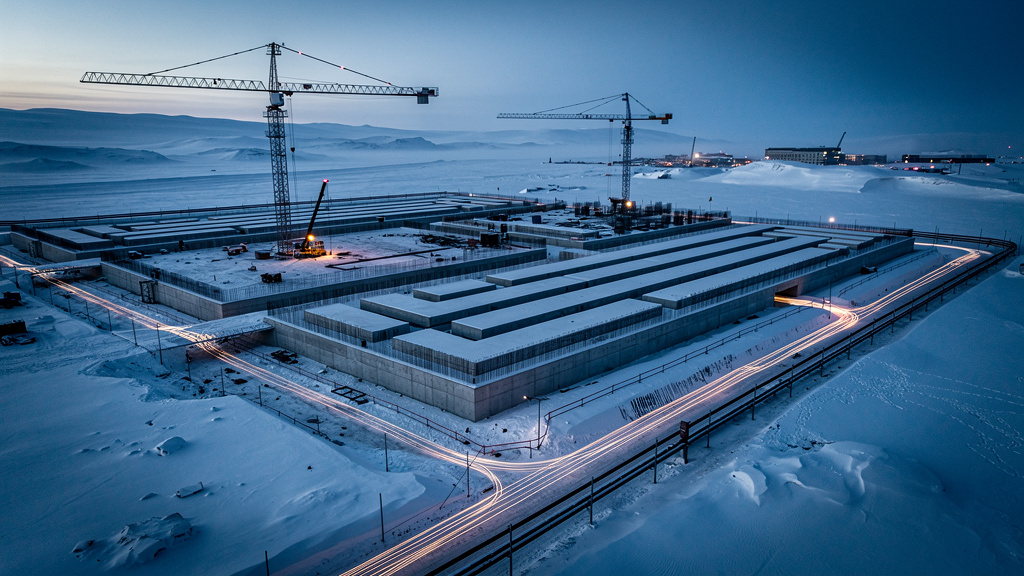
The centrepiece of Nscale’s infrastructure ambitions is Stargate Norway, a joint venture with Aker launched in July 2025 near Narvik in Norway’s far north. The project, powered entirely by hydroelectric energy, aims to deliver 100,000 Nvidia GPUs across 230 megawatts of capacity by the end of 2026, with OpenAI as its initial offtake customer. As part of the Series C, the Aker Nscale joint venture will be fully consolidated into Nscale’s corporate structure. Separately, the company has struck a $14.6 billion deal with Microsoft to deploy 200,000 Nvidia GB300 accelerators across its Texas, UK, and Portuguese facilities.
The three board appointments signal a deliberate shift in the company’s governance profile. Sandberg brings operational scaling experience from her decade running Meta’s commercial engine. Clegg, who served as Meta’s president of global affairs before joining venture firm Hiro Capital, brings regulatory and political navigation. Decker, now CEO of Raftr, brings public-company board experience. The company also completed its first acquisition in December — Future-tech, a British data centre engineering firm employing sixty specialists.
Nscale’s trajectory has been unusually steep. Its $1.1 billion Series B in September 2025, then the largest in European history, was itself a record. The company has now raised over $3 billion in roughly fifteen months. Reports indicate Goldman Sachs and JPMorgan have been engaged as IPO advisers, though no timeline has been confirmed.
The round lands amid intensifying competition in the GPU cloud market, where American incumbents CoreWeave and Lambda have dominated. Nscale’s pitch — vertically integrated infrastructure with a European footprint, renewable energy sourcing, and sovereign data residency — positions it as the continental alternative at a moment when European governments are increasingly wary of dependence on American compute providers.
The Angle
Three billion dollars in fifteen months for a company that did not exist two years ago. The velocity is unusual, but the pattern is not. What Nscale is building — the physical layer beneath every AI model that matters — follows a logic older than the company itself: whoever controls the substrate controls what runs on it.
The board appointments are the more revealing signal. Sandberg, Clegg, Decker — this is not a startup stacking advisers for credibility. This is a company assembling the specific combination of operational scale, regulatory fluency, and public-market readiness that precedes an IPO. The governance is being built to match the valuation, which means the valuation is expected to keep moving.
The European dimension deserves more attention than it is getting. Nscale’s fundraise is not simply large by continental standards. It represents the first serious European bid to own a piece of the physical infrastructure on which the next generation of AI capability will be built. The strategic logic is straightforward: training runs require data centres, data centres require energy and land and regulatory permission, and Europe has all three in quantities that the American market is beginning to find constrained. Stargate Norway — 100,000 GPUs fed by hydroelectric power in the Arctic — is not a vanity project. It is the shape that compute expansion takes when the American grid starts saying no.
The question is whether infrastructure follows capability or the other way around. The conventional reading is that Nscale is a pick-and-shovel play — profitable regardless of which AI company wins. The less comfortable reading is that whoever builds the data centres decides where the models train, and where the models train determines whose regulatory framework, whose energy policy, and whose strategic interests shape the most consequential technology of the century. Nscale is not selling shovels. It is selling geography.
The Signal
The race to build the physical foundation beneath artificial intelligence has produced its first European entrant operating at American scale — and the strategic consequences of where compute lives are only beginning to be priced in.