 Promethean
The Brief
Defense Secretary Pete Hegseth has ordered the amphibious assault ship USS Tripoli, two transport docks, and approximately 2,500 Marines of the 31st Marine Expeditionary Unit from Japan to the Persian Gulf, adding F-35 fighters and Osprey tilt-rotors to the force assembling near the Strait of Hormuz. The deployment, requested by U.S. Central Command to “expand options for operations against Iran,” pulls the only amphibious ready group in the western Pacific toward a waterway that has seen a 94 per cent drop in shipping traffic since the war began two weeks ago.
The Report
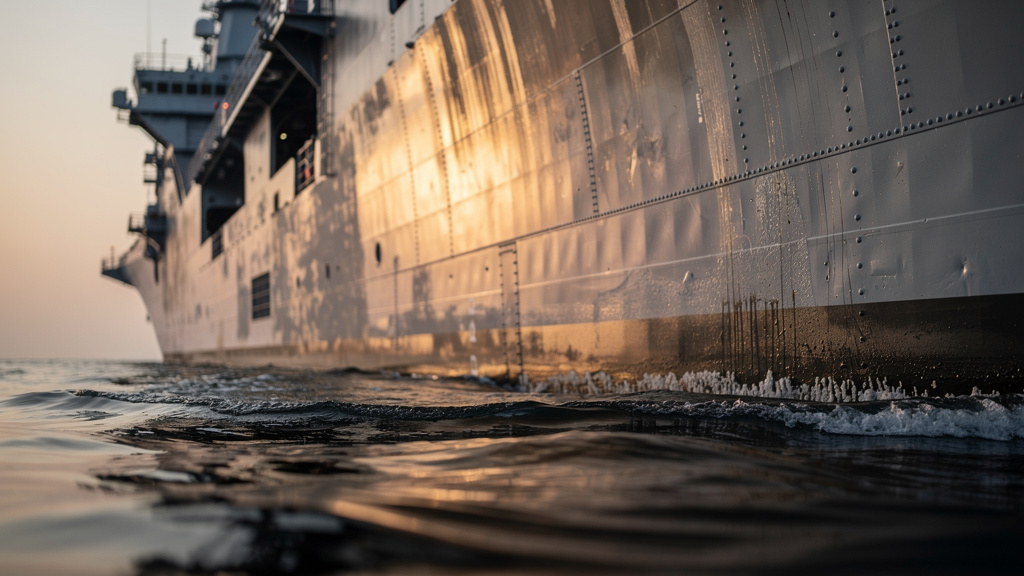
The Pentagon approved the redeployment of the Tripoli Amphibious Ready Group — comprising the USS Tripoli, USS San Diego, and USS New Orleans — along with the 31st Marine Expeditionary Unit from its base in Okinawa, Japan. Satellite imagery shows at least one vessel departed on March 11 at high speed. The Tripoli, an 855-foot America-class assault ship configured as an aviation-focused platform, was participating in the Iron Fist exercise in Japan as recently as Monday before receiving orders. It is more than a week’s sailing from Iranian waters.
The force adds roughly 4,200 to 5,000 personnel — Marines and Navy sailors — to a region already hosting approximately 50,000 U.S. troops, two aircraft carriers, twelve ships in the Arabian Sea, and dozens of bombers operating from RAF Fairford. The 31st MEU brings a ground combat element of roughly 1,100 Marines organised as a battalion landing team, an aviation combat element including F-35B fighters, AH-1Z attack helicopters, and MV-22 Ospreys, and a logistics battalion capable of sustaining operations for up to fifteen days without resupply.
Treasury Secretary Scott Bessent said the U.S. Navy would escort commercial vessels through the strait “as soon as it is militarily possible, perhaps with an international coalition.” Energy Secretary Chris Wright was more direct, telling CNBC: “We’re simply not ready. All of our military assets right now are focused on destroying Iran’s offensive capabilities.” Defense Secretary Hegseth offered a different tone, characterising Iran’s closure of the strait as “sheer desperation” and claiming that Iranian missile volume is “down 90 per cent” and drone attacks “down 95 per cent.” He stated: “Iran has no air defenses. Iran has no air force. Iran has no navy.”
The gap between those assessments and the situation on the water is considerable. Since Operation Epic Fury began on February 28, at least sixteen merchant vessels have been attacked in or near the strait, killing eight seafarers. Only 77 ships transited the waterway this month compared with 1,229 in the same period last year. Brent crude surged above $100 per barrel — up 40 per cent since the war’s start — and the International Energy Agency described the disruption as the largest in the history of the global oil market. Maersk, Hapag-Lloyd, and CMA CGM have halted voyages through the strait. War-risk insurance premiums have spiked, with over 150 vessels anchored outside the chokepoint waiting for conditions to change.
The redeployment also opens a gap in the western Pacific. The Tripoli had been operating in the Philippine Sea and traversing the Luzon Strait south of Taiwan. Navy amphibious assault ship readiness stood at 41 per cent before the deployment order, according to Military Times, following months of heightened counter-narcotics operations in Latin America that created a five-month lapse in expeditionary unit deployments.
Thirteen U.S. service members have been killed since the conflict began — seven by enemy fire and six in a KC-135 refuelling aircraft crash in Iraq. Between 140 and 200 have been wounded. Pentagon officials disclosed in a classified Senate briefing that the first six days of Operation Epic Fury cost approximately $11.3 billion.
The Angle
The administration is running two narratives simultaneously and hoping nobody checks them against each other. In one, Iran is a spent force — no navy, no air defences, drone capacity down 95 per cent, “sheer desperation.” In the other, the United States needs to pull its only Pacific amphibious ready group halfway around the world because it cannot yet reopen a twenty-mile-wide shipping lane. Both of these things are being said by the same government, in the same week, sometimes by the same officials.
The more interesting tension is structural. Fourteen days of sustained air strikes have hit over 6,000 targets — or 15,000, depending on which official is speaking — and degraded Iran’s conventional military to what the Pentagon describes as near-irrelevance. Yet the strait remains closed. The threat that keeps it closed is not the Iranian navy, which has been largely sunk, but the residual capacity to launch cheap drones and missiles at slow-moving tankers in a narrow waterway. Destroying a military is one operation. Securing a chokepoint against asymmetric harassment is a fundamentally different one, requiring persistent presence, mine clearance, and the willingness of commercial insurers to write policies on vessels transiting an active conflict zone. The MEU deployment addresses the first requirement. Nothing announced so far addresses the third.
Meanwhile, the Tripoli’s transit from the Philippine Sea to the Gulf takes more than a week. During that week and for the duration of its deployment, the western Pacific has no amphibious ready group — at a moment when amphibious readiness was already at 41 per cent fleet-wide. The decision to move the piece is not wrong on its own terms. But it is a decision that reveals the size of the board relative to the number of pieces on it.
The 1988 parallel is instructive not for its drama but for its timeline. Operation Earnest Will — the last time the U.S. Navy escorted commercial shipping through these waters — ran for fourteen months. The mine that broke the keel of the USS Samuel B. Roberts came four months in. The question is not whether the U.S. can secure the strait. It is how long “relatively soon” turns out to mean, and what the cost of each additional week of closure does to a global economy that was already priced for stability.