 Promethean
The Brief
The S&P 500 fell 0.8 percent on March 12 to its lowest close since November 2025, while the Dow shed 474 points and WTI crude surged past $94 a barrel — briefly topping $100 — after Iran attacked six vessels in and around the Strait of Hormuz and vowed to keep the world’s most critical oil chokepoint closed. The IEA’s record release of 400 million barrels from emergency reserves, announced the previous day, failed to arrest the rise.
The Report
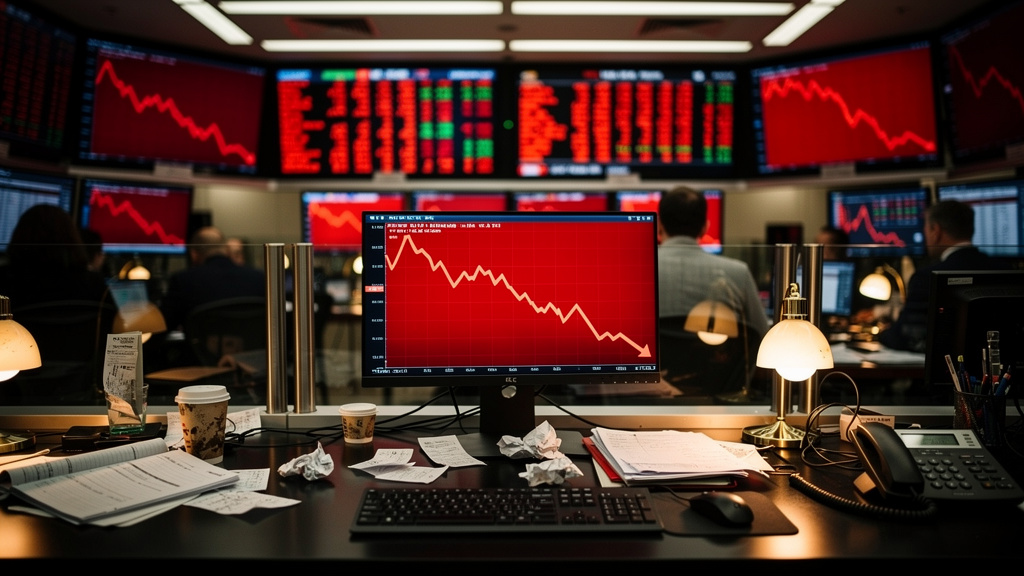
US equities extended their losses on Wednesday as oil prices surged for the second consecutive session, overwhelming a benign inflation print and the largest coordinated reserve release in IEA history. The S&P 500 closed down 54 points at approximately 6,722 — its lowest level since November 2025 — while the Dow Jones Industrial Average dropped 474 points, or 1 percent, and the Nasdaq Composite fell 192 points, or 0.77 percent.
The immediate catalyst was a fresh wave of attacks on commercial shipping. Three cargo vessels were struck overnight in the Persian Gulf, bringing the total to six ships hit in the Strait of Hormuz area over two days. One vessel was struck 11 nautical miles north of Oman, forcing crew evacuation after fire broke out. Iraq closed oil port terminals near Basra following tanker attacks in its waters — the first oil-related strikes in Iraqi territory during the conflict. Storage tanks in Bahrain were torched. Oman evacuated its Mina Al Fahal terminal, which handles roughly one million barrels of daily exports.
WTI crude settled more than 4 percent higher on the day before climbing further in after-hours trading, reaching $94.91 — an 8.78 percent daily gain. Brent crude futures rose as high as $99.35. Both benchmarks briefly exceeded $100 a barrel during the session. Iran’s IRGC warned that “not a litre of oil” would pass through the strait and told markets to expect $200 oil. Mojtaba Khamenei, the new Supreme Leader who assumed power after his father was killed in an Israeli strike on the war’s first day, declared the blockade would continue.
Markets largely looked through the February CPI report, which showed headline inflation steady at 2.4 percent year-over-year and core CPI at 2.5 percent — both in line with expectations. Traders noted the data preceded the oil shock’s full impact. Bond markets reflected the tension: the 10-year Treasury yield climbed to 4.20 percent as traditional safe-haven dynamics broke down under competing pressures of flight-to-safety demand and inflation fears. The VIX held above 25, well clear of its long-term average of 20.
Energy and defence stocks diverged sharply from the broader market. ExxonMobil gained 4.5 percent to $118.40. ConocoPhillips rose more than 5 percent. Lockheed Martin added 6 percent and Northrop Grumman 5 percent. Wells Fargo issued a double upgrade for Occidental Petroleum, citing elevated crude prices and improved Permian productivity.
Deutsche Bank’s Jim Reid warned that investors were “increasingly pricing in a more protracted conflict that causes extensive economic damage.” Ed Yardeni raised his probability of 1970s-style stagflation to 35 percent. Oxford Economics modelled that oil sustained at $140 a barrel for two months would shave 0.7 percent from global GDP by year-end, producing mild contractions across the Eurozone, the UK, and Japan. Prediction markets now place the probability of a US recession this year at 38 percent, up from 24 percent before the war began on February 28.
The Strait of Hormuz, which carries roughly 20 million barrels of oil per day — about a fifth of global seaborne trade — is currently operating at less than 10 percent of pre-conflict capacity. JPMorgan analyst Natasha Kaneva noted that in the entire written history of the strait, it has never been closed.
The Angle
The February CPI number was the story the market wanted to talk about on Wednesday morning. By the close, nobody was talking about it. That sequence is itself the data point worth watching — not the inflation figure, but the speed at which it became irrelevant. A report showing the closest approach to the Fed’s 2 percent target in years was overwritten in a single session by a shipping lane that most investors could not have located on a map three weeks ago.
What the market is pricing now is not an oil spike. Oil spikes have templates — they resolve, traders buy the dip, normality reasserts itself. What the market is pricing is the discovery that the global energy system has a single point of failure that cannot be patched by committee. The IEA’s 400 million barrel release — the largest in its history, more than double the response to Russia’s invasion of Ukraine — bought precisely one day of relief before prices resumed their climb. The tool was designed for supply disruptions. This is an infrastructure closure. The distinction matters: you can supplement reduced flow, but you cannot supplement a chokepoint that has ceased to function.
The stagflation framing is already arriving, and it is the wrong frame applied at the wrong resolution. The 1970s analogy offers comfort because it has a known shape — embargo, recession, recovery, lesson learned. What is actually happening has no precedent. The strait has never been closed. The IEA has never attempted a release at this scale. A US Navy spokesperson has effectively conceded that military escorts are not currently viable. Each of these is a first. Stacking firsts is how you get outcomes that sit outside the range of historical models — which is precisely what the bond market is signalling as yields rise alongside risk-off positioning, two behaviours that are not supposed to coexist.
The Fed meets next week with a mandate that now pulls in two directions simultaneously: an economy softening toward 4.4 percent unemployment and 1.4 percent GDP growth, and an energy shock that has not yet registered in the inflation data it will be asked to respond to. Bank of America’s framing — that conditions favour a dovish response — assumes the shock is temporary. Deutsche Bank’s framing — that each passing day makes the temporary assumption harder to defend — assumes it is not. The distance between those two readings is the distance between a rate cut and a policy trap. The market closed Wednesday without an answer. The strait remained closed.
The most advanced economy on earth discovered this week that its pricing stability depends on a 33-mile-wide waterway it does not control. That dependency was not new. The discovery was.