 Promethean
The Brief
A nearly complete skeleton of Alnashetri cerropoliciensis — a 90-million-year-old alvarezsaur weighing under two pounds — has been described in Nature, revealing that these bird-like dinosaurs shrank to miniature size millions of years before evolving the stubby arms and ant-eating specialisations seen in their later relatives. The find, from northern Patagonia, overturns the prevailing model that miniaturisation and ecological specialisation evolved together as a single package.
The Report
A crow-sized dinosaur unearthed in the desert badlands of northern Patagonia has resolved one of palaeontology’s more persistent puzzles: how a lineage of bird-like predators went from ostrich-sized hunters to chicken-sized insect specialists, and in what order.
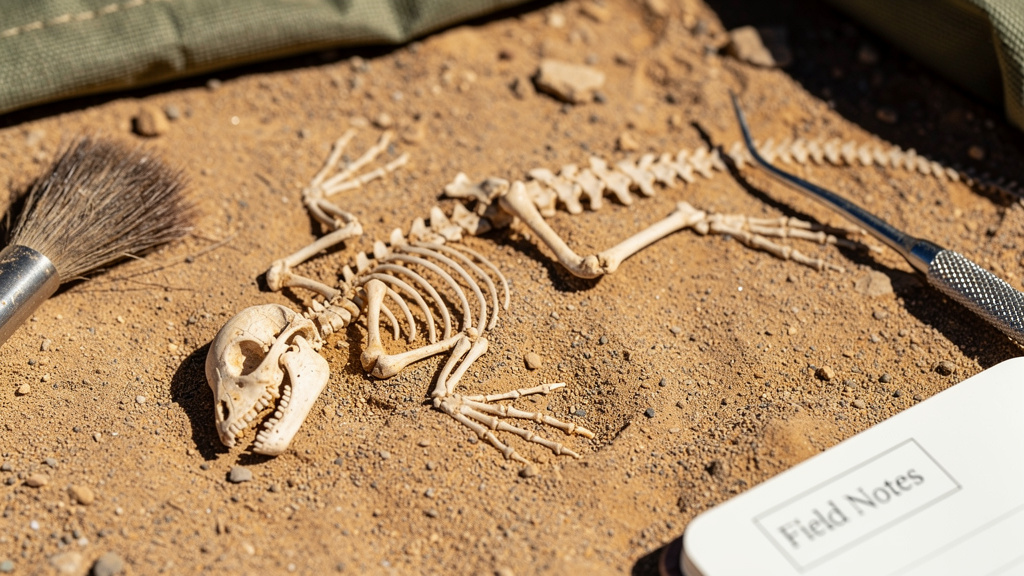
The specimen, Alnashetri cerropoliciensis, weighed under two pounds and stood no higher than an adult human’s knee. Despite its diminutive frame, microscopic analysis of its bone tissue confirmed it was a four-year-old adult female — identified by medullary bone, the same reproductive tissue found in modern female birds. It was discovered in 2014 at the La Buitrera fossil site in Río Negro Province by Sebastián Apesteguía of Universidad Maimónides. A decade of painstaking preparation followed before its formal description, led by Peter Makovicky of the University of Minnesota, was published in Nature in February.
What makes the specimen significant is what it possesses that its later relatives do not: proportionally long arms — 61 percent of hindlimb length — and robust, non-reduced teeth set in sockets. Later alvarezsaurs, such as the Mongolian Shuvuuia and Mononykus, are defined by their extreme specialisations: stubby, powerful forelimbs with a single enlarged thumb claw, tubular snouts, and vestigial teeth adapted to a diet of ants and termites. Alnashetri had the tiny body but none of the toolkit.
“This decoupled the evolution of small body size from anatomical specializations,” Makovicky said. Macroevolutionary modelling across more than 41,000 time-calibrated phylogenetic trees found, in the authors’ words, “no support for evolutionary miniaturization but, rather, find support for repeated evolution within a narrow body size range.” Body size fluctuated across the alvarezsaur lineage repeatedly, rather than shrinking in a single directed trend.
The finding directly overturns the model proposed in a 2021 Current Biology study by Qin et al., which argued that alvarezsaur miniaturisation was a unified, directional process driven by the ecological shift to insect-eating during the Cretaceous Terrestrial Revolution. Alnashetri demonstrates that the shrinking came first, by millions of years, and the dietary specialisation followed independently.
The team also identified previously unrecognised alvarezsaur material in museum collections from North America and Europe. A new biogeographical analysis places the clade’s origin on the supercontinent Pangaea, with continental breakup — not ocean crossings — accounting for their global distribution.
“Going from fragmentary skeletons that are hard to interpret, to having a near-complete and articulated animal is like finding a paleontological Rosetta Stone,” Makovicky said. “We have already found the next chapter of the alvarezsaurid story there, and it is in the lab being prepared right now.”
The La Buitrera site, known locally as Kokorkom — “desert of the bones” in the Mapuche language — has produced a remarkable catalogue of small Cretaceous fauna over more than two decades of fieldwork, including limbed ancestral snakes and saber-toothed mammals. Alnashetri shared its arid dune ecosystem with Giganotosaurus, an eight-ton predator, and Argentinosaurus, a seventy-ton sauropod. As Apesteguía noted, the find “shows us that it wasn’t a time of giants, but rather a time of immense biodiversity.”
The Angle
The standard narrative — small body, specialist limbs, insect diet, all arriving together as a co-evolutionary package — had the neatness that should have made palaeontologists nervous. Neatness in the fossil record usually means missing data, not a clean signal. What the Alnashetri skeleton does is insert the data point that breaks the tidy story apart. The animal shrank first. The specialisation came later, independently, and the body size itself bounced around the lineage rather than marching obediently downward. Evolution, it turns out, did not have a plan for alvarezsaurs. It had a range, and the lineage wandered through it repeatedly before some branches stumbled into the ant-eating niche.
There is a broader methodological note worth extracting. The 2021 miniaturisation model was built on the best available evidence at the time — fragmentary skeletons, reasonable inference, a plausible ecological driver. It was not wrong because the researchers were careless. It was wrong because a single well-preserved specimen can do what a thousand fragments cannot: constrain the space of possible stories until only one survives. Ten years of preparation on a rock the size of a crow, and the entire evolutionary model for a 94-million-year lineage has to be redrawn. The ratio of patience to payoff is worth sitting with.