 Promethean
The Brief
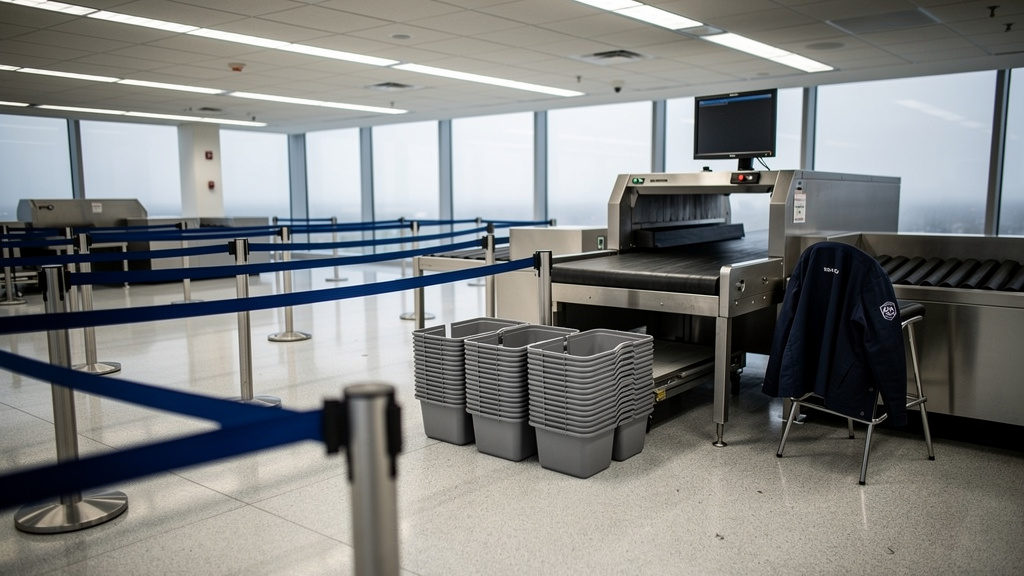
One month into the partial DHS shutdown triggered by a congressional stalemate over immigration enforcement reform, more than 300 TSA officers have resigned and absence rates have tripled nationwide, producing security wait times exceeding three hours at major airports including Houston Hobby and Atlanta Hartsfield-Jackson. The shutdown — the third to affect TSA workers in under a year — has left approximately 50,000 screeners working without pay as spring break travel peaks at an expected 2.8 million passengers per day.
The Report
The Department of Homeland Security funding lapse, which began February 14 over a deadlock between congressional Democrats demanding immigration enforcement reforms and Republicans insisting on a comprehensive funding package, has now produced its most visible public consequence: the partial collapse of airport security throughput during one of the busiest travel periods of the year.
At Houston Hobby Airport, TSA absence rates hit 53% on March 8, with wait times stretching past three hours. Passengers reported lines extending through baggage claim areas. A paramedic response was required after a traveler collapsed in the queue. At JFK, the average absence rate during the shutdown has held at 21%. Atlanta — the world’s busiest airport — has averaged 19%. Nationally, unscheduled absences have tripled from a baseline of roughly 2% to a sustained average of 6%, peaking at 9% in late February.
More than 305 TSA employees separated from the agency between February 14 and March 9, according to internal figures. That follows the loss of approximately 1,100 officers during the October-November 2025 shutdown — a 25% increase over normal attrition for the period. The cumulative workforce erosion is occurring against a backdrop of record passenger volumes: TSA screened 906.7 million passengers in 2025, and the agency expects spring 2026 to set new daily records ahead of June’s FIFA World Cup.
Johnny Jones, secretary-treasurer of AFGE Council 100, which represents roughly 45,000 TSA officers, described members with bank accounts at zero or negative. “They’re panicking, they’re scared, they’re afraid,” Jones said. Anthony Riley, a 58-year-old officer at Syracuse Hancock International, lost his car during last year’s shutdown and has no savings remaining. TSA’s own social media account posted: “A $0 paycheck for those continuing to serve. Enough is enough.”
The political mechanics are straightforward in structure and intractable in practice. Democrats, citing the fatal shootings of two American citizens by federal immigration agents in Minneapolis in January, have refused to fund DHS without reforms requiring judicial warrants for property entry, mandatory body cameras, and restrictions on enforcement near schools and medical facilities. Republicans have blocked five separate Democratic bills to fund TSA, FEMA, the Coast Guard, and CISA independently of the immigration dispute — most recently on March 12, when five bills were rejected in a single 24-hour period. Each side accuses the other of hostage-taking. TSA itself rolled out a video at airports blaming the “Democrat shutdown,” prompting airports in New York, Seattle, and Portland to refuse to display it, citing its partisan nature and potential Hatch Act violations.
Meanwhile, passengers continue to pay the $5.60-per-segment aviation security fee on every domestic flight. The money is collected. It does not reach TSA workers. CEOs of American, Delta, Southwest, JetBlue, UPS, and FedEx published an open letter in the Washington Post demanding Congress restore funding, noting that air travel supports $2.9 trillion in annual economic activity and over 15 million jobs. Acting Deputy Administrator Adam Stahl said the agency has “no significant concerns about the integrity of the screening process right now” but warned the situation will “continue to worsen.” Former administrator John Pistole was less restrained, noting the “huge morale hit” and expressing concern about adversaries identifying perceived vulnerabilities.
The Angle
The interesting detail is not the wait times or the political blame game. It is the fee. Passengers are still paying $5.60 per flight segment into a system that is not paying the people who operate it. The money enters the mechanism. The mechanism does not deliver it. This is not a funding problem. It is a plumbing problem — Congress built a pipe and then installed a valve that a sufficiently motivated minority can close at will.
This is the third time in under a year that TSA officers have worked without pay. The previous shutdown cost the agency 1,100 workers and the travel industry an estimated $6 billion. The current one has already cost 300 more, with absence rates at some airports crossing 50%. Each shutdown degrades the workforce, and each recovery is less complete than the last. The pattern is not dysfunction. It is the system functioning as designed — a governance structure in which the operational continuity of national security infrastructure can be suspended as a negotiating tactic over an unrelated policy dispute.
Both parties describe this as the other side holding something hostage. Neither has proposed the structural fix, which would be unremarkable in its simplicity: decouple essential security operations from discretionary funding cycles entirely. Three bills sitting in Congress would do approximately this. None have advanced. The airline CEOs’ letter asks Congress to pass them. Congress has not, because the hostage is only useful while it remains a hostage.
What no one in the debate has mentioned is the calendar. The FIFA World Cup begins in June. The country’s 250th birthday celebrations run throughout the year. TSA expects to screen record volumes through a workforce that is being actively eroded by a funding mechanism that treats the people standing between passengers and aircraft as an acceptable pressure point. The question is not whether the screening holds. It is what it means that holding is the standard — that the ambition for a $2.9 trillion system is not excellence but survival of the shift.
The officers still showing up are doing so at personal cost that is specific and documented: negative bank balances, lost vehicles, eviction warnings, foregone childcare. The ones who have left are not coming back. The agency knows this from last time. The next shutdown — and the structure guarantees there will be one — will start from a lower baseline. Each cycle removes the people who could least afford to stay and replaces them, eventually, with people who have not yet learned that the job treats their financial survival as negotiable. That is not a workforce strategy. It is a filter for desperation.