 Promethean
The Brief
Researchers at the Institut de Physique du Globe de Paris and GFZ Helmholtz Centre have identified a volcanic precursor signal called “Jerk” — a subtle shift in ground acceleration detectable by a single broadband seismometer — that correctly forecast 92% of eruptions at Piton de la Fournaise volcano over a decade of automated, real-time monitoring. The method, published in Nature Communications, provided warning times ranging from minutes to 8.5 hours before magma reached the surface, and is now being expanded to Mount Etna.
The Report
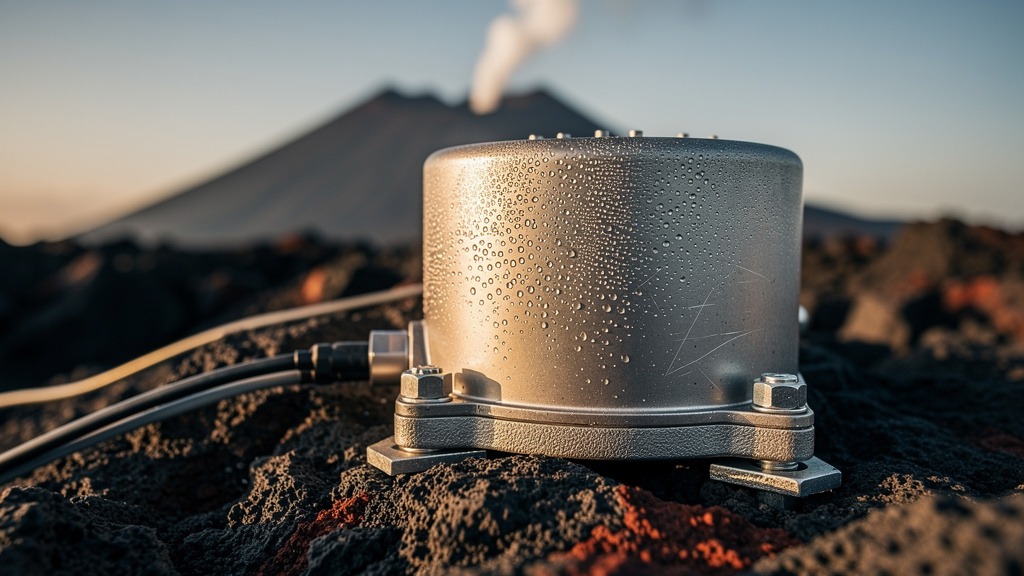
A team led by Dr. François Beauducel has demonstrated that a single broadband seismometer, running fully automated detection software, can identify precursor signals for volcanic eruptions with a 92% success rate across 24 eruptions observed between 2014 and 2023.
The method detects what the researchers call “Jerk” signals — very low-frequency transients in horizontal ground motion corresponding to the third derivative of ground displacement, or the rate of change of acceleration. These signals, generated by dynamic rock-fracturing processes as magma forces open pathways beneath a volcano, register at amplitudes of just a few nanometres per second cubed. The system issues an automatic alert when a characteristic signal exceeds a calibrated threshold, after correcting for interference from Earth tides.
The tool was installed in April 2014 at the OVPF-IPGP observatory on Réunion Island, using data from a Geoscope network station eight kilometres from Piton de la Fournaise’s summit. Its first alert came on June 20, 2014, providing one hour and two minutes of advance notice before an eruption began. Over the following decade, warning times ranged from a few minutes to 8.5 hours. The system was additionally validated against 24 historical eruptions from 1998 to 2010, confirming that the signal appears systematically.
Fourteen percent of alerts were not followed by eruptions. The researchers characterise these not as false positives but as correctly identified magma intrusions that did not reach the surface — “aborted eruptions” corroborated by independent seismic, deformation, and gas data. The most recent detection, on December 5, 2025, registered a signal of just 0.1 nm/s³, confirming subsurface magma movement without subsequent eruption.
“The great originality of this work lies in the fact that the Jerk method was tested and validated in real time in an automatic and unsupervised manner for more than ten years, and not in post-processing of data as is the case in the vast majority of studies of eruptive precursors,” said Dr. Philippe Jousset, co-author and scientist at GFZ’s geophysical imaging section.
The team plans to deploy the method at Mount Etna in Italy beginning this year through the POS4dyke project, using broadband seismometers supplied by GFZ’s Geophysical Instrumental Pool. A parallel initiative, SAFAtor, is exploring the use of fibre-optic cables for complementary early warning capability.
Fewer than half of the world’s approximately 1,550 potentially active volcanoes are monitored by ground-based sensors. An estimated 800 million people live within 100 kilometres of an active volcano.
The Angle
The significant detail is not the 92% figure, impressive as it is. It is the instrument count. One seismometer. The standard approach to volcanic monitoring deploys dozens or hundreds of sensors across multiple networks — seismological, GPS, tiltmeter, gas analysis, camera — and still struggles to produce reliable real-time forecasts. The prevailing difficulty in eruption prediction has been treated as a complexity problem: not enough data, not enough instruments, not enough coverage. The Jerk method suggests it may have been, at least partly, a resolution problem. The signal was always there. It sat in a frequency band and a derivative order that the existing analytical framework was not examining.
What makes this operationally consequential is the gap between where the method works and where the need is greatest. Piton de la Fournaise runs roughly a hundred instruments across five monitoring networks. It is, as the researchers note, almost laboratory-like. The volcanoes that kill people — Fuego, Nyiragongo, Merapi — are not laboratory-like. They are monitored sparsely or not at all, in countries where the cost of a dense sensor network is prohibitive. A method that requires one broadband seismometer does not merely improve the existing monitoring architecture. It changes who gets access to it.
The Etna deployment will begin to answer whether the signal generalises beyond basaltic shield volcanism to more explosive settings. That question matters more than anything in the paper. A tool that works on one well-behaved volcano is a research achievement. A tool that works across volcanic types, deployable for the cost of a single instrument, is the difference between prediction as a capability reserved for wealthy observatories and prediction as a standard available wherever the ground is restless.